


Don't miss your future favorite film!
Subscribe to our newsletter and get the latest updates from the SIFF community delivered straight to your inbox.
Don't miss your future favorite film!
Subscribe to our newsletter and get the latest updates from the SIFF community delivered straight to your inbox.
Tova Gannana | Monday, February 23, 2026
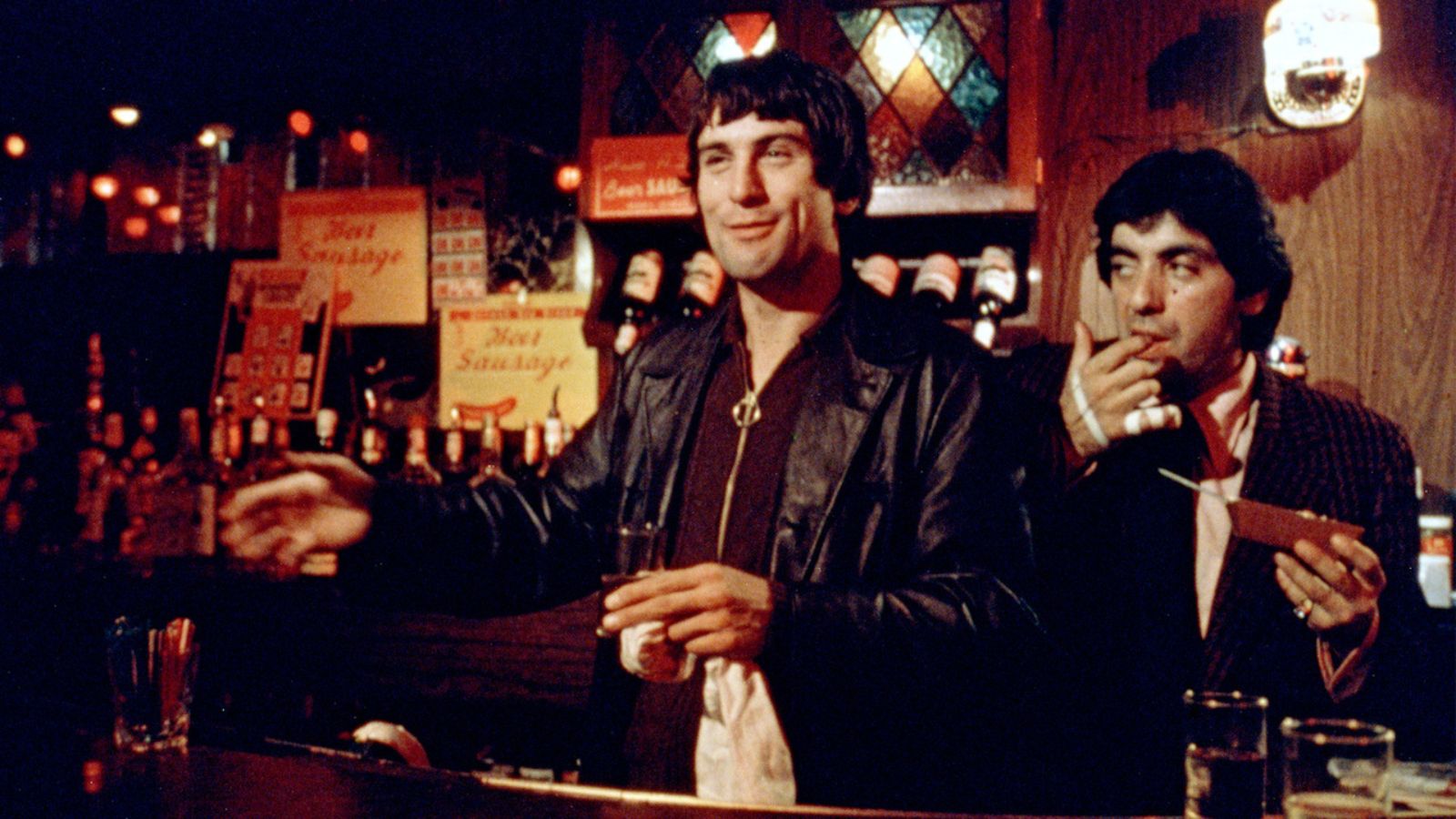
Mean Streets (1973) film notes by Tova Gannana for the Martin Scorsese: Maestro of Cinema series, presented by SIFF, Festa Italiana and Greg Olson Productions. Series curated by Martin Scorsese and Greg Olson, written by Greg Olson. The series runs through April 2026 at SIFF Cinema Uptown.
Moonlight on a pillow. A man in a white tank top is woken by his dream. A mirror on the wall, sirens outside, and then the music of The Ronettes singing about the night we first met. Charlie Cappa (Harvey Keitel) is a suit in the neighborhood, dancing in the audience among tables at his friend Tony’s (David Proval) basement bar while women dance naked on stage. Charlie runs numbers, is in the mob by way of his Uncle Giovanni (Cesare Danova). Charlie is full of warmth and feeling. He isn’t removed, but involved. Penance and how you repent is what consumes Charlie: the scales of justice. What is mean is reality, and what is mean if not meant? The meanness of the streets is both random and directed.
Charlie’s uncle sees the neighborhood as transactional. He isn’t susceptible to the inhabitants the way Charlie is, charlie is impressionable, he is porous. Giovanni is cold; he sits in his living room and watches a movie on TV, a film he may’ve already seen. Charlie and his friends Tony, Michael (Richard Romanus), and Johnny Boy (Robert De Niro) go to the movies more than they go to church. In Tony’s bar, they philosophize. The bar is like the underworld: men and women in stages of undress and slumber. The movies they see are like their lives – violent, expressive, comic, filled with music. Their neighborhood is like a film set: festivals of saints parading, we see the neighborhood at night with the lights strung across the streets, bright as stars hung low, touching the buildings, illuminating the pavement. Charlie and his friends are in the thick of it. No one can catch a moment alone.
Charlie’s inner monologue peppers the film. Talk about penance and look who walks through the door, Charlie says to himself. Johnny Boy is Charlie’s charge. One night, he fires his pistol from a rooftop wanting to wake up the neighborhood. He says he wants to shoot a clothesline in half and hit the lights on the Empire State Building. Johnny Boy answers Charlie back with questions. He’s always asking, “What?” but he leaves off the “t” so it sounds like “Whaaa?” Johnny Boy has two tabs at Tony’s bar: a short-running tab and a long-running one: put liquor on a tab, put leaving your neighborhood on a tab, put making a decision about living differently than your pals on a tab, put life on a tab. The tab is more than a list; it’s a reputation. What’s good for
Johnny Boy isn’t good for Charlie.
In Mean Streets (1973) Italians are played by a Christian Arab, a Puerto Rican and two Jews. In Mean Streets the neighborhood’s borders are physical, yet at the same time invisible. It’s the music that pushes the neighborhood, that pulses and pumps, an artery connecting Charlie and his friends to the rest of America. At any given party, laughter will turn into screams. Such a party is thrown at Tony’s bar for a returning Vietnam vet. There are streamers, shots, beer, dancing, and speeches. Late into the night when everyone is drunk, while suffering a flashback, the vet attacks a young woman on the dance floor. Charlie and his friends intervene, stopping what needs to be stopped. They’re not bystanders; it’s their space, and they’re in control. Charlie comforts the young woman in a back room, dancing with her as he holds her. Charlie’s uncle has a birds-eye view of the neighborhood while Charlie’s view is that of the worm’s.
Teresa (Amy Robinson), Johnny Boy’s cousin, having undressed in front of windows, having rolled around naked in a hotel bed with Charlie, stays dressed for the rest of the film. Her red sweater up to her neck, in a yellow vest she carries her groceries in a brown bag, she tells Michael in a stairwell, who is looking for Johnny Boy, to go to hell, her baguette and eggplant end up on the floor.
An hour into Mean Streets, Charlie crouches before a bedroom window in his parents’ apartment and peers through the blinds past the fire escape into Teresa's window as she peels off her nightgown. In Charlie’s room, Johnny Boy lies on his bed, as if to say “The neighborhood is always present”. Teresa’s swimsuit bottom has left a tan line, marking her in shadow and sun. Teresa tells Charlie “I love you” while he smiles and tells her not to tell him that. Teresa has epilepsy, and has a seizure in a hallway. Charlie will leave her briefly for Johnny Boy. Teresa and Johnny Boy are indivisible for Charlie, like two sides of a coin; he loves them both.
Michael, who has loaned Johnny Boy money, is charging him interest, is threatening to kill him “or worse”. Michael calls Johnny Boy “a jerk off”; Charlie calls Johnny Boy “a good kid.” Teresa wants to move to the Village, and she wants Charlie to come with. Johnny Boy is like the needle nearing the label on a record: The record will need to be flipped.
The neighborhood is about to change. One day the neighborhood will get up, stretch, yawn and turn a corner. Nothing personal, it’s just what neighborhoods are wont to do, like songs on the radio, one year they are called provocative the next they are considered easy listening.
Undecided about his own life, Charlie focuses on saving Johnny Boy from Michael, which is to say, the neighborhood. Up until then, Charlie had always been a passenger. Throughout the entire film we see his indecision, his arguing about staying or leaving, about who needs to pay up and whose debts should be forgiven. Fleeing in a moment of panic over the bridge to Brooklyn, away from their neighborhood in Manhattan, Teresa sits in the middle, with Johnny Boy and Charlie on either side. The energy in the car is like that of driving to the hospital to give birth.
Don't miss your future favorite film!
Subscribe to our newsletter and get the latest updates from the SIFF community delivered straight to your inbox.
Don't miss your future favorite film!
Subscribe to our newsletter and get the latest updates from the SIFF community delivered straight to your inbox.