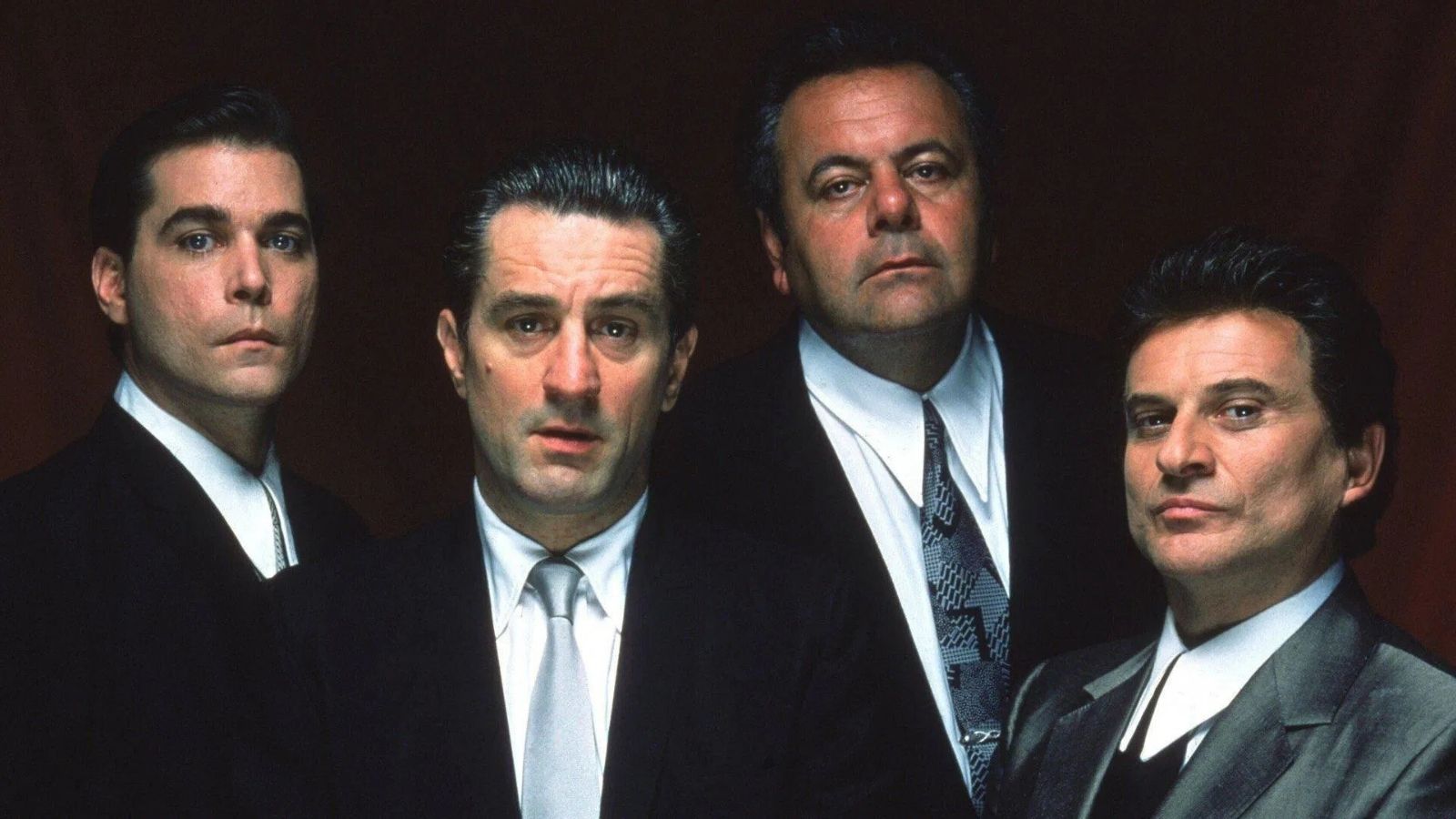
Goodfellas: After the Music Stops
Henry Hill, still a kid, watches the neighborhood gangsters across the street: the cars, the suits, the ease with which they move through the world. “To me,” he tells us, “being a gangster was better than being President of the United States.” The line lands with a strange mixture of innocence and certainty. It is both naïve and completely convincing. This is where the film begins, not with crime, but with attraction. And that attraction never really goes away.
From the outset, Martin Scorsese constructs a cinematic world that does something morally disorienting. It invites us to take pleasure in the lives of men who are, in any conventional ethical sense, irredeemable. These are not romantic antiheroes in the classical sense. They are thieves, extortionists, abusers, and murderers (to say nothing of being horrible friends, fathers, and husbands). Yet the film asks us to laugh with them, to feel their triumphs, and to experience their collapses as something like a personal loss. The question is not whether Goodfellas endorses or condemns its characters. It does something far more complicated than either. It asks what it means that we enjoy this, in a way that only cinema can do.
Henry Hill, played by Ray Liotta, does not simply narrate events. He confides in us. The voiceover acts as less of a commentary and more as creating a sense of inclusion and odd intimacy. We are brought inside the rhythms of this world, not just by what happens, but by how it feels. The camera moves with a seductive fluidity, most famously in the Copacabana tracking shot, where Henry escorts Karen, played by Lorraine Bracco, through back hallways and kitchens, bypassing lines and protocols. It makes privilege feel smooth, effortless, and intoxicating. (SIDE NOTE: when you watch this scene, ask how many times do we see a fire hose? This speaks volumes about what Henry is doing here)
Goodfellas is often described as a revisionist gangster film, but it is just as productively understood as a film about memory, both personal and cinematic. It remembers the gangster films of the 1930s, such as The Public Enemy and Scarface, in which criminal life is framed as both alluring and doomed. Those films oscillate between fascination and moral closure, offering spectacle alongside punishment. Scorsese inherits this structure but removes its stabilizing mechanisms. There is no final moral reckoning that restores order, no sense that justice has been meaningfully served. Henry ends the film not as a tragic figure, but as “an average nobody” who gets the “live the rest of [his] life like a schnook.” The punishment is not death, but banality. This shift matters. In classical gangster films, death resolves the tension between attraction and condemnation. The criminal must die so that the audience’s pleasure can be retrospectively justified. In Goodfellas, that resolution never arrives. The pleasure remains, even as the world collapses.
At the same time, the film recalls Scorsese’s own Mean Streets, where Catholic guilt and moral anxiety structure the narrative. In that earlier film, Charlie struggles to reconcile his loyalty to friends with his sense of sin. Goodfellas strips away that interior conflict. There is no character here who mediates between the audience and the world of crime through moral reflection. Instead, there is Henry. And Henry does not judge.
If Goodfellas is morally complicated, it is because it operates less as an ethical argument than as an emotional funhouse. It produces feelings such as exhilaration, humor, anxiety, and nostalgia, and allows those feelings to coexist without resolving them into a clear moral position. Consider the film’s humor. Much of it is rooted in timing, performance, and repetition. The famous “Funny how?” scene, anchored by Joe Pesci’s volatile Tommy DeVito, moves rapidly between comedy and threat. We laugh, then hesitate, then laugh again. The scene destabilizes our response, making us aware of how quickly pleasure can turn into fear and then back again. Thus, violence in the film is not presented as purely horrifying. It is often abrupt, even absurd. A man is stabbed repeatedly in the trunk of a car while the soundtrack pulses with energy. A young waiter is shot in the foot as a kind of in-joke. These moments do not invite moral reflection so much as they short circuit it. We react before we can evaluate. This is where Scorsese’s cinema intersects with questions of spectatorship. The film reveals how easily we can be aligned with perspectives that, under other circumstances, we would reject. It does not excuse this alignment. It exposes it.
To understand this better, it is best to think of Goodfellas as a kind of musical. Not in the conventional sense, since there are no characters breaking into song, but in the way that music organizes time, emotion, and movement. The film’s soundtrack, which spans decades of popular music, does more than set the mood. It drives the film forward, creating rhythms that shape our experience of events. Scenes unfold like numbers. They have beginnings, crescendos, and releases. The editing is often synchronized to the music, producing a sense of flow that carries us through moments that might otherwise feel disjointed or disturbing.
The “Layla” montage, which accompanies the discovery of bodies after the Lufthansa heist, is a particularly striking example. The images are grim, with corpses in cars, in dumpsters, and in meat trucks, yet the music is lyrical and almost beautiful. The juxtaposition does not cancel out the violence. It reframes it, turning death into a kind of melancholic choreography. Similarly, the cocaine fueled helicopter sequence near the film’s end transforms paranoia into rhythm. The rapid cuts, the layering of sounds, and the constant motion all produce a sense of acceleration that is as exhilarating as it is exhausting. We are caught up in Henry’s subjective experience, even as it spirals out of control. In this sense, Goodfellas does what musicals have always done. It externalizes feeling, turning internal states into audiovisual patterns. The difference is that here, those patterns are attached to a world of crime and excess. The pleasure of the musical form is redirected toward morally troubling ends. In doing so, it leaves us caught between the rush of what we feel and the unease of what we know.
Goodfellas endures not because it offers answers, but because it stages a problem. It confronts us with a form of spectatorship that is deeply uncomfortable, one in which pleasure and moral unease are not opposites, but coexisting conditions. The film does not ask us to choose between attraction and judgment. It asks us to recognize how easily they intertwine. In this sense, Goodfellas is not simply a film about gangsters. It is a film about us, about the ways cinema shapes our responses, aligns our sympathies, and trains our perceptions. It reveals how images, sounds, and rhythms can draw us into worlds we might otherwise reject. It is, in the end, a film about learning how to feel, and what it means to discover that those feelings are not as stable, or as innocent, as we might like to believe.