


Don't miss your future favorite film!
Subscribe to our newsletter and get the latest updates from the SIFF community delivered straight to your inbox.
Don't miss your future favorite film!
Subscribe to our newsletter and get the latest updates from the SIFF community delivered straight to your inbox.
John Trafton | Tuesday, April 28, 2026
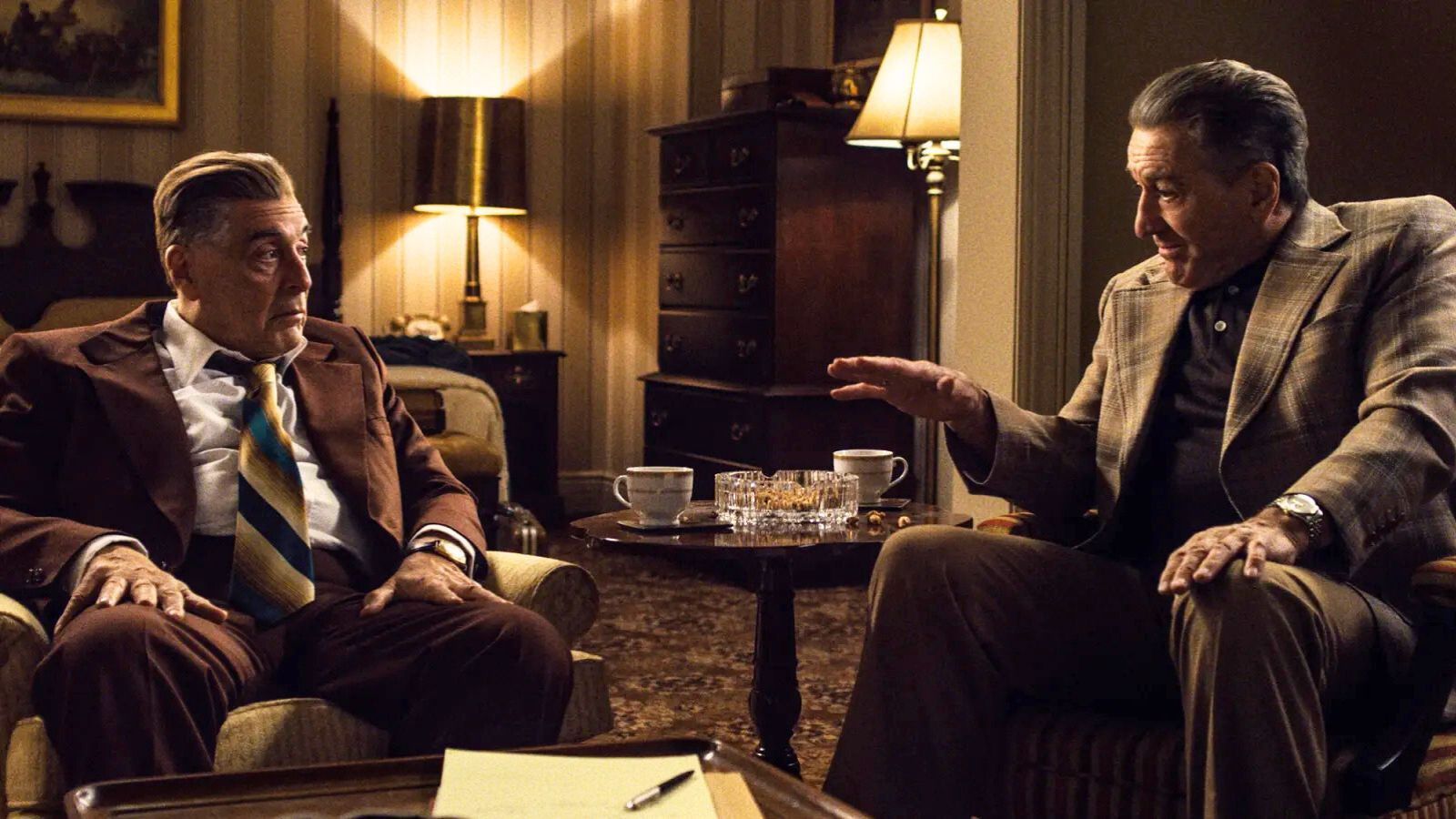
Full confession: I am not a fan of The Irishman. I know this seems like a strange way to kick off your experience of the film. But hear me out, as I’m willing to bet that it will increase your enjoyment of the film, because it will challenge you to find things that I’m missing. Don’t get me wrong. I don’t hate the film, nor do I “dislike it.” I just don’t think it stands alongside Goodfellas, Mean Streets, and Casino as well as I wanted it to. Then again, maybe that’s where I went wrong with my first viewing? Let’s dive in and find out.
First, this film is essentially a Scorsese family reunion. Robert De Niro is back and just as good as ever. Joe Pesci makes a very welcomed return. Harvey Keitel returns after a long hiatus since The Last Temptation of Christ. And then there’s Al Pacino joining the gang, alongside Anna Paquin, Jesse Plemons, and Ray Romano. But even here, something feels different. If this is a reunion, it is not a celebratory one. The energy is quieter, more restrained, as if the film is less interested in showcasing these figures than in observing what remains of them. Robert De Niro’s Frank Sheeran does not command the screen with the charisma of Jimmy Conway or Sam Rothstein. He recedes into it. His voiceover does not confide so much as it reports, offering details without guiding our emotional response. Where earlier Scorsese films invite us in through rhythm and seduction, The Irishman seems almost determined to hold us at a distance.
There is also the little issue of the film’s controversial use of de-aging technology. This was certainly not the first time this technology had been used during the 2010s, and it foreshadowed debates over AI reproduction technology in the 2020s. At first, this can feel like a distraction. The bodies do not always move the way we expect them to. The illusion falters. But over time, that instability begins to register differently. These are not simply younger versions of the same characters. They are older men remembering themselves as younger men, and the gap between those states never fully disappears. The technology does not smooth over time. It makes us aware of it: its weight, its persistence, its refusal to fully resolve into a clean image.
This sense of temporal dislocation extends beyond the technology itself. It shapes the entire rhythm of the film. If Goodfellas moves with velocity, propelled by music and momentum, The Irishman unfolds with a kind of deliberate slowness. Scenes linger. Conversations stretch. Violence, when it appears, arrives without spectacle and disappears just as quickly. There is no choreography, no transformation of brutality into rhythm. There is only the fact of it, presented without emphasis. If Scorsese harnessed the electric energy of film history to propel his earlier films, then here he pivots to a more contemplative approach. This may give us a window into his headspace when he wrote his February 2021 article for Harper’s Magazine, titled “Il Maestro,” in which discusses his feelings about cinema vs. “content.” Through this lens, special effects in Marvel films are spectacle, and in The Irishman they are psychological.
One of the most striking things about The Irishman is how little it seems interested in seducing us. Earlier films draw us into their worlds through rhythm, humor, and escalation. Here, that logic has been replaced by something closer to inevitability. The film does not build toward excitement so much as it drifts toward outcomes that feel already decided. It is not about what will happen, but about what has already happened and how it is remembered. This shift becomes especially clear in the film’s treatment of Jimmy Hoffa, played with restless energy by Al Pacino. Hoffa seems, at first, to belong to a different film altogether, one defined by movement, charisma, and volatility. He brings with him a rhythm that recalls the earlier Scorsese world: loud, animated, alive. And yet, that energy does not transform the film around him. It is gradually absorbed, diminished, and ultimately erased. The film does not rise to meet Hoffa. It waits him out.
What emerges from all of this is a different kind of gangster film, one that looks less like an immersion into a world of power and more like a reflection on what remains after that world has faded. Relationships dissolve. Institutions weaken. The codes that once structured meaning begin to lose their coherence. What we are left with is not the thrill of participation, but the residue of having once participated. In this sense, The Irishman begins to resemble an afterimage of Goodfellas and Casino. It is what those films look like when their rhythms have slowed, when their energy has dissipated, when the systems that sustained them can no longer hold. It does not negate those earlier films. It reframes them, asking us to reconsider what their pleasures were built upon and what happens when those pleasures are no longer available.
So now I’ve given you some things to talk about, and to be honest, I can feel my opinion of the film starting to shift. I want you to enjoy your experience of The Irishman, but before you do, it’s worth asking whether—what initially feels like a lack of energy, of propulsion, of the pleasures we associate with Scorsese—is actually something more deliberate. What if the film is not failing to recreate the experience of Goodfellas, Casino, or even Wolf of Wall Street, but actively refusing it? He brought the band back together, yes, but they’re not playing their greatest hits (and that’s a good thing).
Which brings me back to my opening confession. What I initially experienced as distance, as a failure of the film to engage me in the ways I expected, now feels more like a challenge. The film asks us to sit with a different kind of experience, one that is less immediately gratifying but perhaps more enduring and timelier. It asks us to exchange exhilaration for reflection and momentum for duration. So no, I don’t think The Irishman stands alongside Goodfellas, Mean Streets, and Casino in the way I once hoped it would. But I’m no longer convinced that it’s trying to. And the more I sit with that possibility, the more the film opens up: not as a lesser entry in Scorsese’s body of work, but as something stranger, quieter, and, in its own way, more unsettling.
Which is precisely why I’m going to watch it again.
Don't miss your future favorite film!
Subscribe to our newsletter and get the latest updates from the SIFF community delivered straight to your inbox.
Don't miss your future favorite film!
Subscribe to our newsletter and get the latest updates from the SIFF community delivered straight to your inbox.