


Don't miss your future favorite film!
Subscribe to our newsletter and get the latest updates from the SIFF community delivered straight to your inbox.
Don't miss your future favorite film!
Subscribe to our newsletter and get the latest updates from the SIFF community delivered straight to your inbox.
Ryan Saunders, NFFTY Managing Director | Tuesday, July 14, 2026
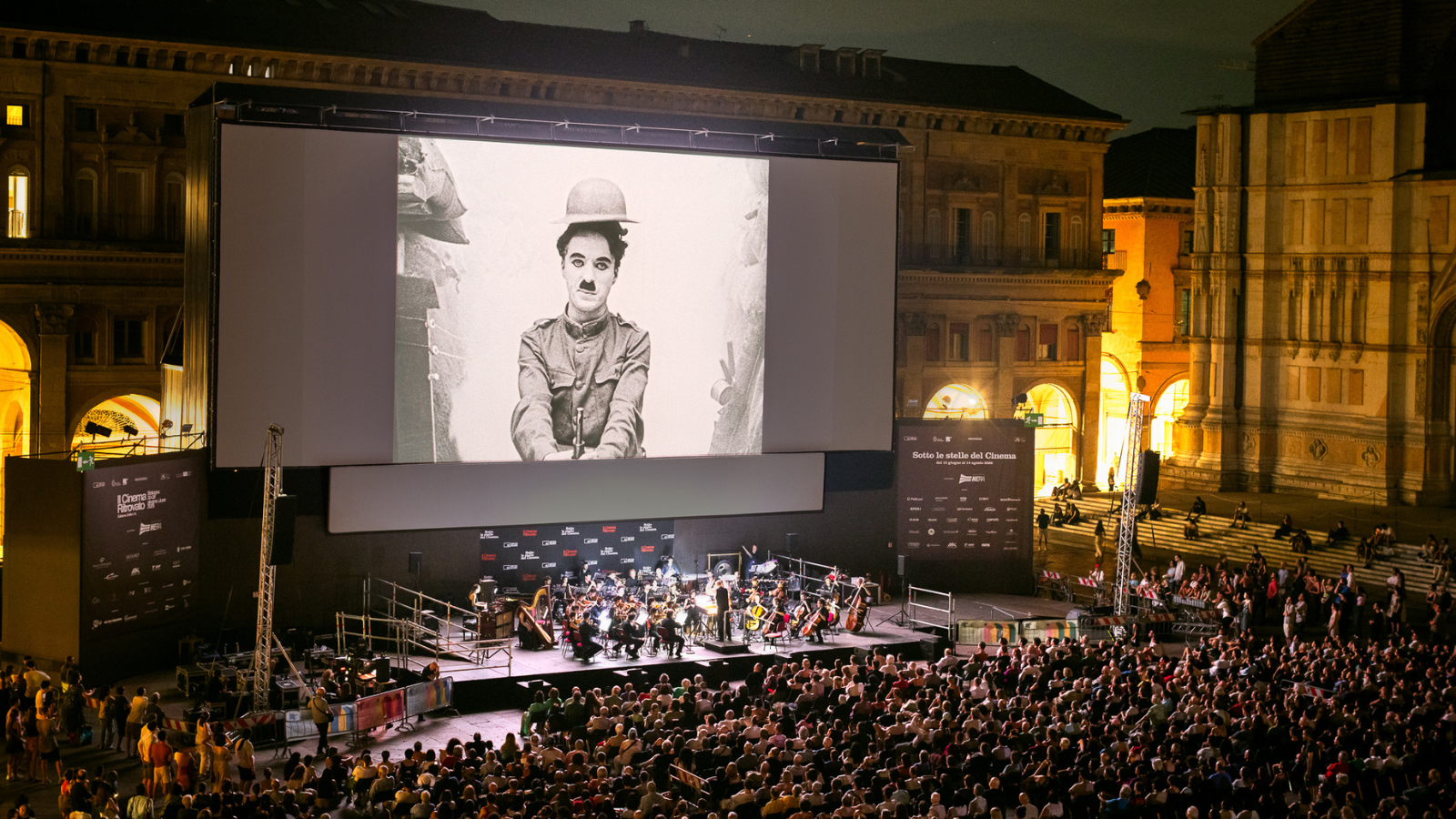
“There is a very specific type of cinephile in the room this evening,” announced Ehsan Khoshbakht, one of Il Cinema Ritrovato’s four Festival Directors, “who opted for a 3D Jerry Lewis film on the opening night of our festival.” Around 7,000 people were gathered under the stars in the grand Piazza Maggiore to watch the world premiere restoration of the 1927 masterpiece Sunrise accompanied by a full orchestra. There were less than 200 of us (including fellow Seattleites Tommy Swenson and Shanya Nowicki of The Beacon Cinema) in the underground Cinema Modernissimo for Paramount’s 3D restoration of Money From Home (Marshall, 1953), eager to see newfound depth in Lewis’s idiosyncratic mugging. What better way to celebrate 100 years of Jerry?

For nine volcanically hot days in Bologna, I had the great privilege of immersing myself in the programs of Il Cinema Ritrovato, a cinephiles’ paradise of restorations and rediscoveries. The festival consisted of over 500 films across nine venues presented to an audience of 145,000, creating an electric atmosphere of shared wonder for all that is possible within the medium. From morning til night, I experienced 27 features and five shorts programs, a selection of titles spanning every decade of the 20th century and representing works from the US, France, India, Spain, the Philippines, the UK, Sweden, Italy, Japan, Iran, Finland, the Czech Republic, Russia, Hong Kong, and Germany. My only regrets are that I was unable to fit in even more titles from the expansive lineup.
One day at Ritrovato might look something like the following: bidding farewell to the middling air conditioning in your accommodations to grab an espresso and croissant, heading into the Cinema Lumiere to watch a silent masterpiece accompanied by world class musicians and the hum of Italian cicadas outside, sprinting over to another venue at 11:00am for a classic Hollywood screwball as your stomach starts to grumble, fitting in a quick pizza before crossing back through Bologna’s “Parco 11 Settembre 2001” to attend a grouping of enchanting shorts from 1906, dipping into a 16mm experimental program of Gunvor Nelson shorts to whet your appetite, having bolognese for dinner (again), and then sitting with thousands in the medieval outdoor Piazza for a gala world premiere restoration, and then maybe (if you have the courage) sneaking into a midnight screening of a brand new 35mm print of Plan 9 From Outer Space (Wood, 1957). At every turn, you find yourself encountering another iteration on what cinema is, was, and could be.
In a way, each subsection of the program functions as its own mini festival, one that helps guide your preferred route through the abundance of titles. Barbara Stanwyck was the glamorous poster image for this year's XL edition, befitting one of the titanic performers of classic Hollywood. Our first film of the festival was an archival print of Ladies of Leisure (Capra, 1930) which, despite being a creaky early sound title with some middling performances, was perfectly programmed to draw extra attention to Stanwyck’s undeniable screen presence. Her charming turn in Howard Hawk’s masterful screwball Ball of Fire (1941) was a jolt of electricity midway through the festival, especially with the built-in amusement of the laser Italian subtitles attempting to translate the slang-laden dialogue. I still feel as though I’m recovering from King Vidor’s classic weepie Stella Dallas (1937), a notably intense moviegoing experience and possibly the longest I’ve continually cried throughout a film. “Ah yes, a two hankie picture,” a friend said to me after I reported on the experience, but in my case it was closer to three; I had at least five cumulative minutes of the film visually obstructed by my tears. The audience of over 300 folks felt as though they were catching their breath when the lights came up.
One of the main reasons I wanted to experience the festival was for two subsections that return with each edition: 100 Years Ago (films from 1926), and A Century of Cinema (films from 1906). The former proudly proclaims that it is not a best of list, but instead a survey of what was happening in cinema 100 years ago, conventional or otherwise. All silent films are presented with world class live accompaniment, from traditional piano to accordion, flute, drums, and everything in between. Oftentimes the pre-film shorts stole the show; while The Three Million Trial (Protazanov, 1926) amusingly felt like Soviet Lubitsch, the Charles Bowers Now You Tell One (1926) was an eye opening extravaganza of mixed media filmmaking. I found the queer coded readings of Girl in Tails (Swanström, 1926) to be somewhat generous for what was ultimately an uneventful film, but it was a stroke of inspiration to include What’s the World Coming To? (Jones/Wallace, 1926), a gender-bending short set “100 years from now, when men have become more like women and women more like men,” next to Women Adopt Men’s Fashion, a Fox Newsreel of women trying on men’s clothes in Seattle, WA! 
One of the standout films in the 100 Years Ago category was a 35mm presentation of Lev Kuleshov’s By the Law (1926), screened in the outdoor Piazzetta Pasolini on a carbon arc projector. These vintage machines do not utilize bulbs but instead feature brilliant light emitting from an electric arc split across two carbon rods. Pairing old fashion projection with a contemporary score of fugelhorn, mandocaster, banjo, electric guitar, and trumpet was a compelling anachronism. The thrill was especially heightened when, following the grisly murder at the beginning of By the Law, a reel fell off the projector and we saw the image tear on screen. They were professionals and had the show back on track surprisingly fast; this technical skill and proficiency was consistently evident throughout every presentation at the festival. (Though I find it curious that the Bologna cinemas do not mask various aspect ratios on scope screens…)
An amusing sub-section of the silent cinema presentations was the Matinée Idols program, spotlighting four hunks of the early 1920s who were more or less studio designed marketing strategies to capitalize on women attending cinemas during the day. I admired their perversity of screening footage of Rudolph Valentino’s 1926 funeral in front of a feature designed to make audiences thirst after his charm and boyish good looks. Attendees were provided with a poll card to vote on which idol you found most talented, as well as most attractive. My vote went to Richard Bathelmess, who knocked the wind out of me with the captivating Tol’able David (King, 1921). I’m not sure who took home the top prize, or what they won for that matter, but it was a pleasant diversion.
Retreating even further into the past, the Century of Cinema: 1906 section was sublime, transporting audiences to the magical world of the cinematograph. Nearly all of the selections were presented on 35mm and organized in themed blocks that fulfill the programmers ethos that early cinema is not necessarily a “film,” but a “film program.” These were all accompanied by the world class talent of Stephen Horne’s piano, flute, and accordion (sometimes playing them simultaneously), and Eduardo Raon use of the harp in a way I had not realized was even possible. I had tears in my eyes simply watching a tinted print of Niagara Falls and hearing the way Roan emulated the sound of water. Of particular note was the programmer’s philosophy that early cinema is unreasonably excluded from discourse around avant garde cinema, as it was one of the most experimental periods in film history simply by definition: they were inventing the art form!

The curatorial ethos extended through special introductions across the majority of the films, such as film writer Molly Haskell contextualizing Ladies of Leisure, tribute guests like Wim Wenders speaking on their favorite Lang films, archives or producers commenting on their recent initiatives, or even such inspired programming as Roger Corman’s daughter Mary introducing The Terror (1963) on Father’s Day. For me, the most moving introduction was when Angie Chen, over 40 years after Shaw Brother Studios went out of their way to bury her film, dedicated the restored version of My Name Ain’t Suzie (1985) to her mother. She watched the film with us, and I’ll forever cherish the joy in her eyes when the film ended and she received a standing ovation from the predominantly young audience.
Other films received passionate introductions by archives and restoration teams, who spoke on how these rediscovered titles found their way back to the cinemas. It was exhilarating to attend the world premiere restoration of Lino Brocka’s Weighed But Found Wanting (1974), a powerful social realist work from the Philippines that further cements his status as a grand master (attendees even received limited edition small press books from Carlotta films). At the screening of Ebrahim Golestan’s 1974 satire Secrets of the Jinn Valley Treasure, Ehsan Khoshbakht shared how at the end of Golestan’s long life at the age of 100, he pleaded to Khoshbakht to “please do something with this film.” These screenings reminded one of the power, responsibility and impact that comes with restoring works, and the privilege of being able to witness the results.
During the retrospective of Daisuke Ito, a figure generally unknown in the west but revered in his native Japan, the National Film Archive of Japan spoke with reverence on the print condition for their restoration of Gero No Kubi (Ito, 1955), presented on a 35mm print struck directly from the original nitrate (a rarity for Japan). You come to recognize throughout the festival that access to original nitrate negatives are generally a unique luxury, as many archives find themselves scavenging for the highest quality safety or interpositive prints. My biggest regret of the festival was missing out on one of Ito’s silents accompanied by a Benshi, live narrators of early Japanese cinema who performed alongside the films.
Searching high and low for the best available elements is par for the course for the remarkable work being accomplished by the Film Heritage Foundation. Thanks to their herculean efforts, the diversity of India’s cinema has earned a prominent position within the festival, this year with multiple restorations and an entire section dedicated to Bengali filmmaker Ritwik Ghatak. Before experiencing the delightfully strange Ajantrik (Ghatak, 1958), FHF Founder Shivendra Singh Dungarpur highlighted the herculean efforts of the sound team on the restoration, who proudly stood for their round of applause. I attended a session on the restoration process for Amma Ariyan (Abraham, 1986) and Pakeezah (Amrohi, 1972), in which Shivendra spoke on the responsibility of accurate color reproduction and the research required when dealing with suboptimal elements. Similarly, Valeria Camporesi of the Filmoteca Española spoke on the unique challenges in their 4K restoration of the masterful working class comedy El Puente (Bardem, 1977), presented within a retrospective of Spanish filmmaker Juan Antonio Bardem, in that the films’ muted look was a reality of shooting independently in a rebuilt industry in post Franco Spain and not something they should artificially saturate to be more aesthetically pleasing.
In many respects, the screening of Pakeezah (Amrohi, 1972) felt like the true discovery of the festival. In his introduction, Shivendra Singh Dungarpur shared how it was one of his life goals to restore Sholay (screened last year at Il Cinema Ritrovato) and Pakeezah, an enthusiasm made even more evident by the fact that the restoration was not 100% complete but they were so eager to share it with us. Filmmaker Kamal Amrohi conceived this melancholic Urdu musical as a star vehicle for his wife Meena Kumari. Production began in the 1950s on B&W film, but decided to start from scratch when he discovered the possibilities of shooting in color. After seeing Guru Dutt utilize cinemascope, Amrohi was motivated to restart production a third time. By 1964 only a portion of the film was completed, the couple separated, Kumari became a star, and over the next five years her health gradually deteriorated. She returned to set in 1969, determined to complete the film despite being visibly weak and ill, and died a few weeks after the film was finally released in 1972. The resulting film is a haunting masterpiece; the sudden shifts in age feel accidentally experimental in execution, a happenstance of production that somehow manages to invite various readings on the character’s internal state.

Every evening culminates in a grand outdoor screening in the Piazza Maggiore, the central square of Bologna. The festival places over 2,000 seats in front of the massive screen, but additional hordes of people bring their own chairs, sit at nearby bars, or on the steps of a medieval Basilica. Thousands were in attendance for the world premiere of the Wild at Heart (Lynch, 1990) restoration, in part due to Isabella Rosselini being in attendance for a delightful introduction to a film. Having rewatched recently, we stayed for around 40min of the film before calling it a night, but suffice to say it is a profoundly strange film to see projected outdoors to such a large audience.
With some self awareness of the season, the festival programmed the Finnish silent Curses of the Witch (Puro, 1927) in the hopes that the snowy landscapes of Lapland would cool us down. The film was presented as a cine-concert with live accompaniment by the Finnish avant garde band The Cleaning Women, who provided one of the greatest original scores I’ve heard for a silent film. That, plus the haunting wintry landscapes, helped me endure the 168 title cards across the 89min (made more overwhelming by being in both Finnish and Swedish with embedded English subtitles and laser Italian subs below the screen).
The festival climaxed on the penultimate evening with two new restorations of Charlie Chaplin shorts, A Dog’s Life and Shoulder Arms (1918), introduced by critic (and my favorite capsule writer) Dave Kehr. During his introduction, Kehr explained the significance of what we were witnessing. In the rapidly growing film industry of the 1910s with an increasing demand across various markets, filmmakers would intentionally film multiple takes so more than one finished negative could be shipped out. America would receive the “A” negative composed of takes with the best performances and timing, Europe would receive the “B” negatives of alternate shots, and so on down the line with “C” and “D” negatives. When Chaplin re-released the shorts as part of the The Chaplin Revue in 1959, the “A” negatives were presumed lost and he composed new scores from surviving elements. MOMA has spent years tracking down every “A” print they could find across collectors and cinematheques in an effort to fully reconstruct what American audiences saw in 1918. Being surrounded by an audience of thousands in rapt attention at the history lesson, and then subsequently in hysterics from the timeless grace of Chaplin’s cinema, left me feeling as if I was living in an alternate reality. To top it all off, the orchestral score (which had to be slightly retimed from Chaplin’s 1959 composition due to the alternate footage) included a moment when the conductor sat down to play a musical saw.
The festival ended with a Piazza screening of Young Frankenstein (Brooks, 1974), presented on Mel Brook’s 100th birthday. Beforehand, they filmed us all singing in an Italian rendition of Happy Birthday (assisted by karaoke projection on screen), which was later sent to Mel. I hope he appreciated that. The screening left me in a reflective mood, as it was one of my childhood favorites thanks to the comedic influence of my father. Early in the festival we were able to Facetime from the back of the crowd; based on his bug eyed expression, I don’t think he ever thought his affection for film would result in his son celebrating the art form with the rest of the world in Italy. It was the perfect film to conclude my first Il Cinema Ritrovato, a festival that recharged my batteries and reminded me of why I fell in love with cinema in the first place.
Don't miss your future favorite film!
Subscribe to our newsletter and get the latest updates from the SIFF community delivered straight to your inbox.
Don't miss your future favorite film!
Subscribe to our newsletter and get the latest updates from the SIFF community delivered straight to your inbox.