


Don't miss your future favorite film!
Subscribe to our newsletter and get the latest updates from the SIFF community delivered straight to your inbox.
Don't miss your future favorite film!
Subscribe to our newsletter and get the latest updates from the SIFF community delivered straight to your inbox.
Tova Gannana | Tuesday, March 31, 2026
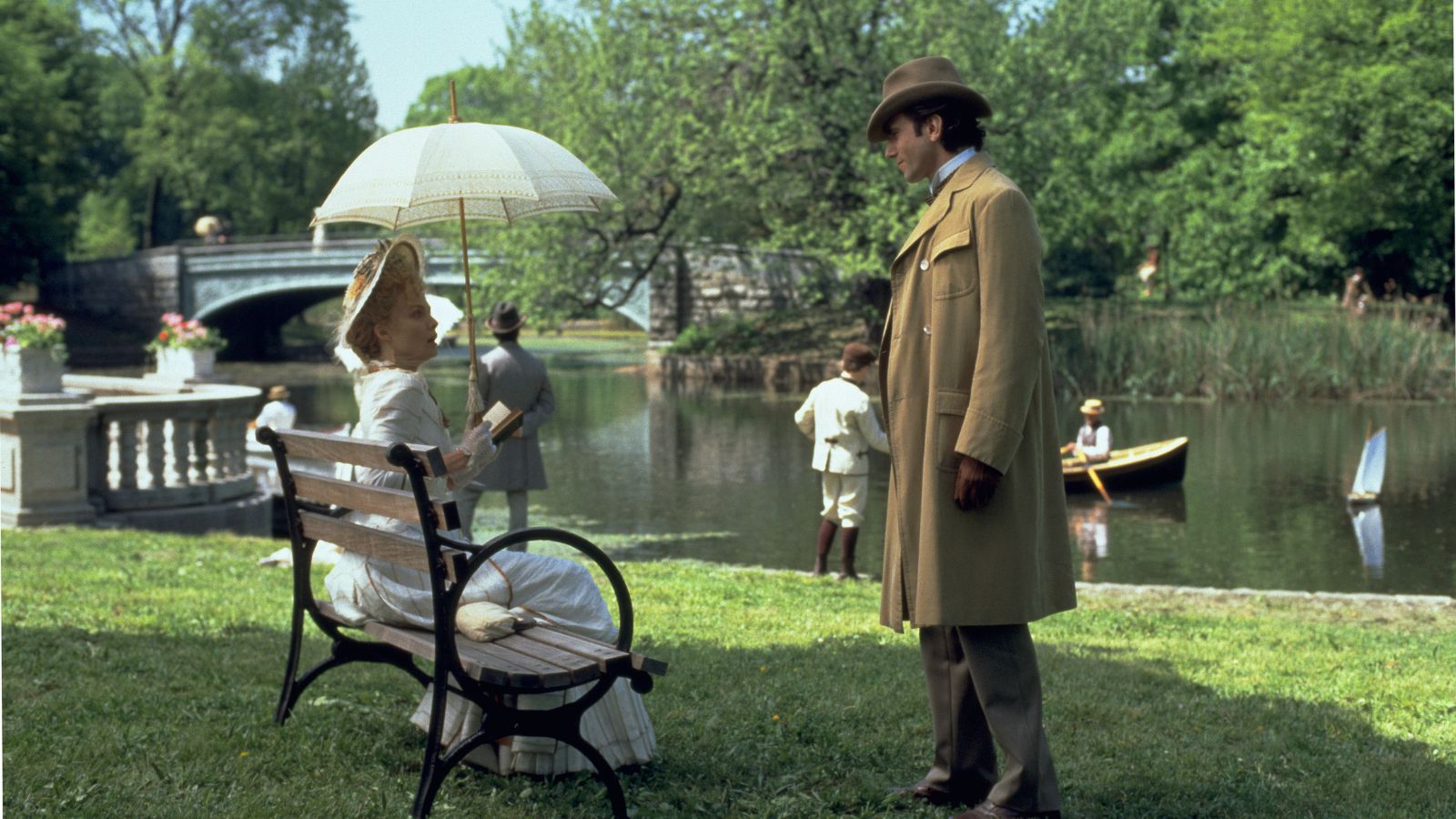
Archer thinks Countess Olenska “most plaintive and poignant”; he wonders about May: “What if all her calm, her niceness, is just a negation, a curtain dropped in front of an emptiness?” The very things that bring Archer and Countess Olenska together are what drive them apart: a sense of duty, curiosity, kindness. Archer extends his family support to include Countess Olenska; she in turn urges him to go through with his marriage to May so that both he and her won’t be left out of the social fray. In thinking of one another over their own happiness, they cause themselves deep regret. We know that for Archer, it’s lifelong. We see him in his old age.
This is his story: We begin with him in his opera box, wearing a boutonnière to match the others. He hears gossip and looks toward where Countess Olenska has just taken her seat. His jaw tightens. He is decisive: He exits, he climbs the stairs. At the end of the film he is also seated, but outside, in a courtyard in Paris, his years evident in his grey hair. He looks up toward Countess Olenska’s window, slightly opened, curtains blowing in a carefree breeze. At this point, he is anything but moveable.
Wharton and Scorsese were both party to a New York City that is in the past: the Gilded Age and Mean Streets, times when adhering to Old World customs were part and parcel of surviving. Of course you could move to an apartment in the Village but could you go back home again?
Countess Olenska has been away a long time, when at the opera she waves her black feathered fan and tells Archer, “…so long I’m sure I’ve been dead and buried and this dear old place is heaven.” Later she admits that that was naïve: “It seems stupid to have discovered America only to make it a copy of another country.” As a woman, she is constrained on both continents. She ends up back in Europe. We never see her again, only her apartment window, which is shut by a male servant as a sunbeam hits the pane and momentarily blinds a settled Archer.
The Basses created the film titles for North By Northwest (1959), Vertigo (1958), Psycho (1960). From the 1960s to the mid 1980s, they were hired less by directors: “Whatever the reasons, the result was ‘Fade Out.’ We did not worry about it; we had too many other interesting projects to get on with. Equally, because we still loved the process of making titles, we were happy to take it up again when asked. ‘Fade In’...”
Hitchcock kept his backdrops as paintings even after it was considered old fashioned to do so. When in New York and in Europe, filmmakers were shooting on the street, his productions kept veteran artisans working, a ship in Marnie (1964) painted at port, never meant to set sail. Is what Archer regrets not that he married May – the wrong woman – but rather that he didn’t stand up for himself against what was chosen for him? Instead going along with what was fashionable at the time, and not because of anything other than certain social death.
Don't miss your future favorite film!
Subscribe to our newsletter and get the latest updates from the SIFF community delivered straight to your inbox.
Don't miss your future favorite film!
Subscribe to our newsletter and get the latest updates from the SIFF community delivered straight to your inbox.