


Don't miss your future favorite film!
Subscribe to our newsletter and get the latest updates from the SIFF community delivered straight to your inbox.
Don't miss your future favorite film!
Subscribe to our newsletter and get the latest updates from the SIFF community delivered straight to your inbox.
John Trafton | Wednesday, September 16, 2026
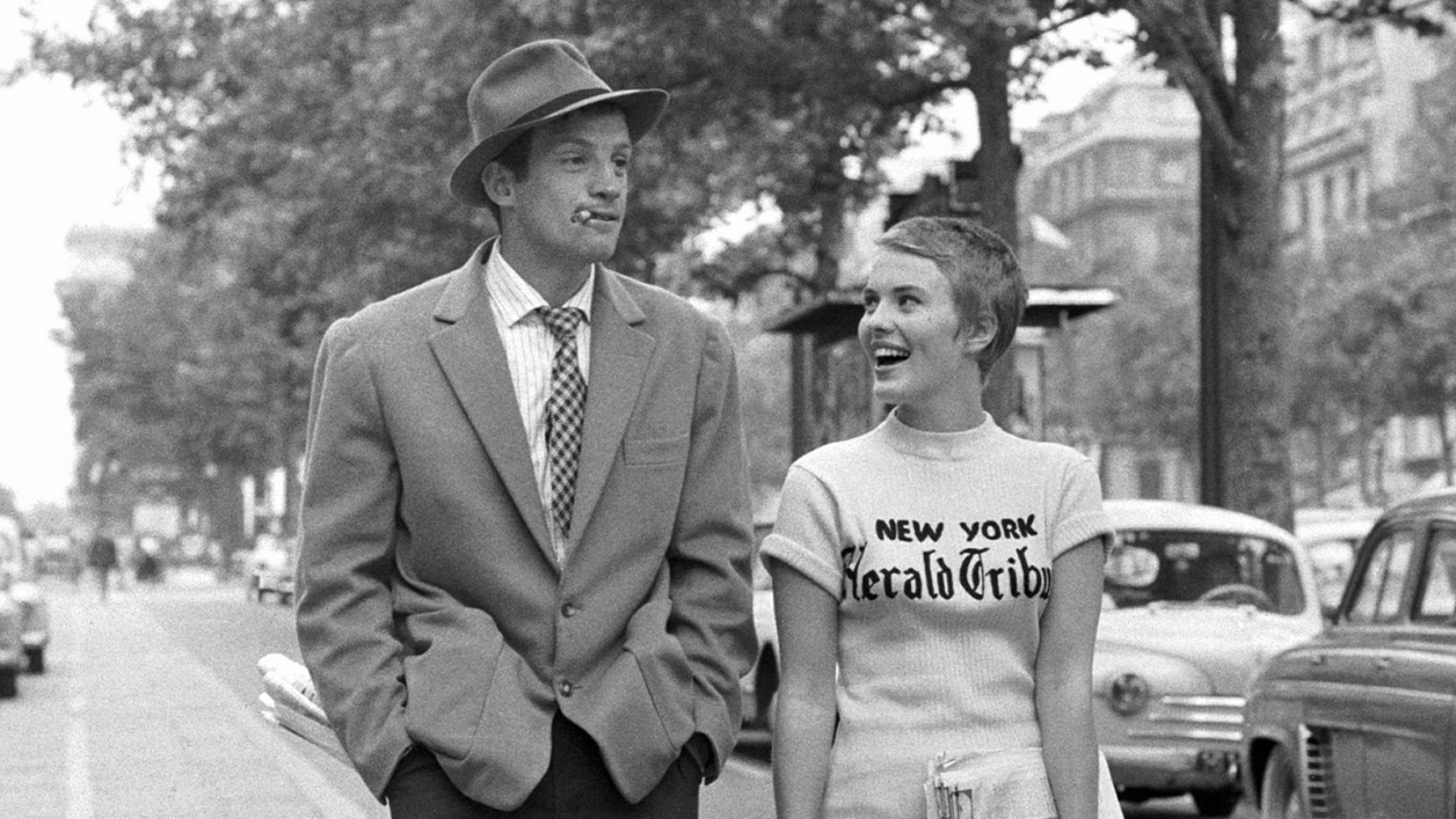
I used to drive myself crazy trying to figure out what kind of movie Breathless is. Crime film? Romance? Meta-criticism? All of the above? I always pictured Jean-Luc Godard watching my dilemma from somewhere, tapping his fingertips together and mustering up a Mr. Burns-style “Excellent.” Eventually, it hit me. This movie is cool. End of story.
I’ve always bristled at the word “cool” when it is used to describe a film. It feels like a critical escape hatch, a way of saying that something works without having to explain why. People said it about Tarantino in 1994. But somehow the word has never bothered me with Breathless. Cool seems almost fundamental to the film’s DNA.
But what makes it cool? Jean-Paul Belmondo? Certainly. He has that Bogart-esque combination of brooding movie-star charisma and small-time crook desperation. The jump cuts? Absolutely. Godard’s gleeful disregard for classical film form helped change the grammar of cinema. But by the time I first encountered Breathless, the jump cut no longer seemed particularly radical. Music videos had appropriated it. David Lynch had scrambled cinematic continuity. David Fincher had turned fragmentation into an extraordinarily precise visual language. Godard’s revolution had been so successful that generations of filmmakers had absorbed it.
Looking back, I think what really made Breathless cool for me was Jean Seberg. Her Patricia Franchini remains one of the most indelible figures of the French New Wave: the striped shirt, the cropped hair, the copy of the New York Herald Tribune tucked under her arm as she walks the Champs-Élysées. But Seberg’s importance to the film goes deeper than iconography. Patricia seems to exist simultaneously inside the movie and slightly outside it. She can be playful, affectionate, detached, curious, selfish, uncertain. Michel desperately wants life to resemble the movies. Patricia never quite agrees to play the role he has written for her. That distinction gets at what made the French New Wave revolutionary in the first place.
Godard famously believed that the best way to criticize cinema was to make cinema. Breathless emerges from a moment when criticism, theory, and filmmaking began collapsing into one another. Godard and his fellow critics at Cahiers du cinéma did not simply write about the movies they loved and hated. Eventually, they picked up cameras and started arguing with film history through images. Alexandre Astruc had already provided a name for this possibility with his idea of the caméra-stylo, or “camera-pen”: the notion that a filmmaker might use a camera with the freedom and intellectual flexibility that a writer uses a pen. Cinema could think. It could criticize. It could wander, digress, contradict itself, quote other movies, and change its mind. Breathless feels like the moment someone actually grabs that pen and starts scribbling in the margins of film history.
Its low-budget roughness is therefore not something the film needs to overcome. It is part of the point. At moments, Breathless has the exhilarating quality of a student film made by people who have just discovered that the rules are flexible. Cameras go into the streets. Continuity fractures. Characters address us. Scenes run too long or end too abruptly. Hollywood gangster movies collide with Italian neorealism, whose location shooting and attention to ordinary spaces had already demonstrated that cinema did not need the machinery of the studio to create a world. The influence is visible everywhere in Godard’s Paris, a city that feels observed rather than constructed. There is also something Brechtian about all of this. The jump cuts and discontinuities repeatedly remind us that we are watching something that has been assembled. Instead of disappearing behind seamless technique, filmmaking announces itself. The movie does not simply tell a story; it asks us to notice the process by which movies turn stories, people, gestures, and faces into meaning.
This is where Seberg becomes so important. Her performance never feels entirely containable. Patricia is an American in Paris, but Seberg herself also arrives in Breathless carrying another cinematic history with her. She had already been transformed into a Hollywood star by Otto Preminger, appearing in Saint Joan and Bonjour Tristesse. Godard takes that recognizable movie-star image and places it inside something looser, stranger, and more unstable. Seberg seems liberated from the machinery that was supposed to manufacture her as a conventional star. The result is a performance that still feels startlingly modern.
Perhaps that is why Patricia's striped shirt and short haircut have become so inseparable from our cultural memory of the New Wave. They don't merely signify a particular fashion. They signify possibility. Seberg looks like someone who has wandered out of one kind of cinema and discovered that another kind can exist. That may be why Breathless feels so necessary right now. The things Godard and the New Wave were responding to have not disappeared. If anything, cinephiles are arguing about remarkably similar problems: fossilized industrial practices, the economics of filmmaking, the relationship between criticism and creation, and the fear that cinema has become too cautious about what it is allowed to be. Breathless offers no blueprint for solving those problems. What it offers is something more useful: permission. Make the movie cheaply. Take the camera outside. Steal from the films you love. Argue with the films you hate. Let criticism become practice and practice become criticism. Treat film history not as a mausoleum of masterpieces but as raw material.
Above all, refuse to let film history feel settled. Jean Seberg embodies that refusal. More than sixty-five years later, Patricia still walks through Paris looking as though cinema has just been invented and nobody has decided what its rules are yet. Film history, Breathless reminds us, is not merely something we record. It is something we do.
And then, of course, there is Godard himself. The sunglasses. The provocations. The contradictions. The man whom Mark Cousins memorably called “cinema’s greatest terrorist.” But that is another story.
For now, watch Seberg.
Don't miss your future favorite film!
Subscribe to our newsletter and get the latest updates from the SIFF community delivered straight to your inbox.
Don't miss your future favorite film!
Subscribe to our newsletter and get the latest updates from the SIFF community delivered straight to your inbox.