


Don't miss your future favorite film!
Subscribe to our newsletter and get the latest updates from the SIFF community delivered straight to your inbox.
Don't miss your future favorite film!
Subscribe to our newsletter and get the latest updates from the SIFF community delivered straight to your inbox.
John Trafton | Wednesday, September 23, 2026
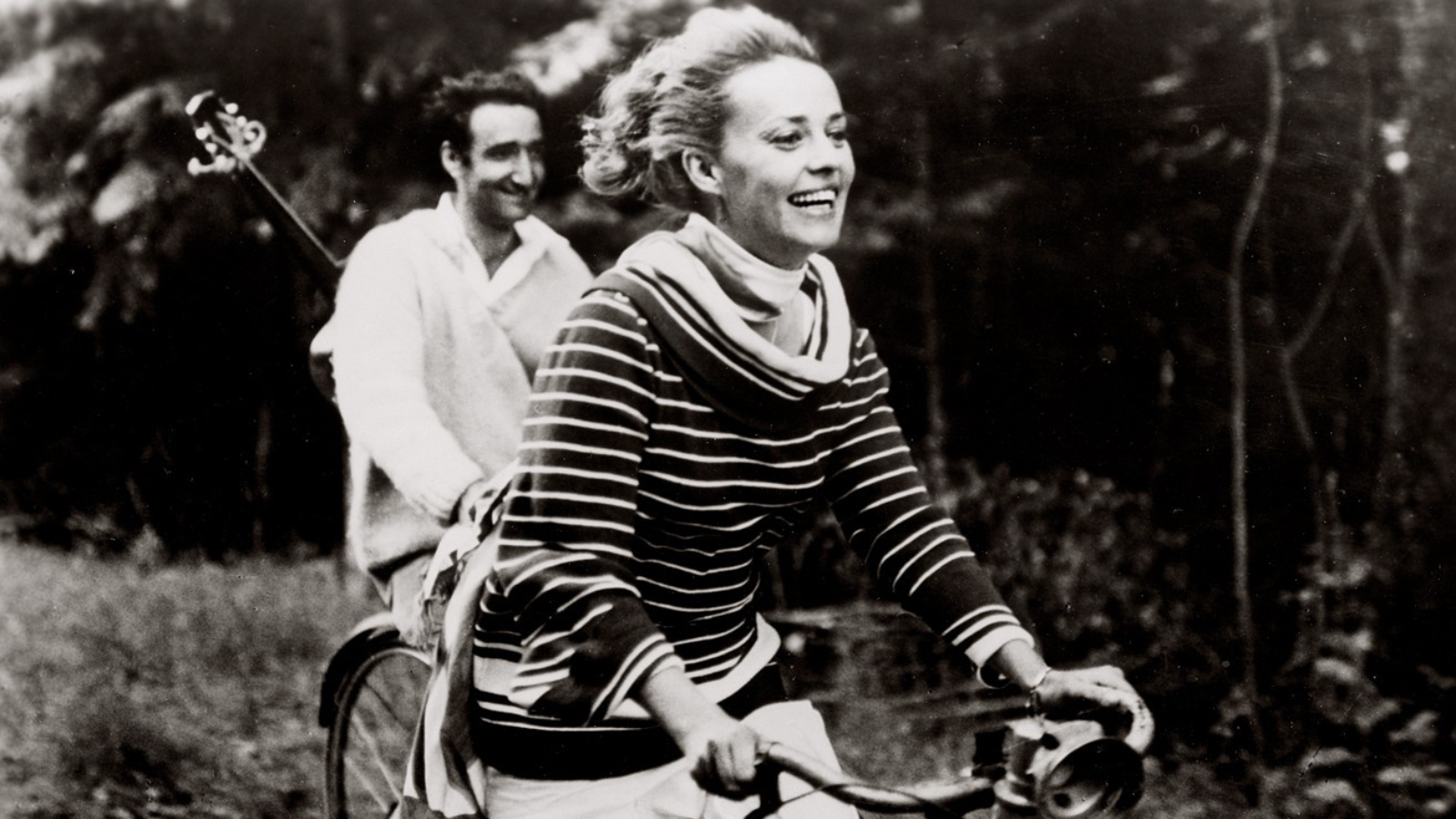
Catherine sings the whole movie before we quite realize it.
In “Le Tourbillon de la vie” (“The Whirlwind of Life”), lovers meet, separate, find one another again, and are swept apart once more. Catherine sings while Jules and Jim watch her, but the song belongs to more than their love triangle. It describes the rhythms of Jules and Jim itself: movement, chance, reunion, repetition. The promise is exhilarating. The consequences are another matter.
Consider that famous run across the bridge. Catherine cheats. Dressed as “Thomas,” complete with a drawn-on mustache, she bolts ahead of Jules and Jim before the race has properly begun. She is defiant, independent, and refuses to play by society’s rules. Gender becomes performative. Catherine temporarily escapes the role assigned to her, but there is something larger happening here as well. She destabilizes both the two men running alongside her and the audience watching them. Catherine is the French New Wave, but more importantly, she is no damn accessory for these men. She may not be in the title, but she sure as hell is the film’s center of gravity. Catherine is why Jules and Jim feels alive, and much of that life comes from Jeanne Moreau.
Moreau embodied the transnational possibilities of cinema in almost the opposite way from Jean Seberg. Her boundary crossing was both figurative and literal. She worked with Michelangelo Antonioni, Orson Welles, Luis Buñuel, Elia Kazan, Rainer Werner Fassbinder, and Wim Wenders. Yet Moreau was never simply an ambassador for the French New Wave. Her career suggests a kind of cinematic liberation that could not be contained within a single national cinema or movement. Watching her now makes our contemporary notion of the “international star” seem strangely limited by comparison.
There is, however, a trap waiting inside all this talk of liberation. Before Jules and Jim meet Catherine, they encounter a statue. Its mysterious smile fascinates them. When Catherine enters their lives, the image seems to have materialized into a woman. The doubling is appropriate for a film whose very title announces a pair, but it also introduces one of the film’s most troubling questions: what happens when men transform a living woman into an aesthetic ideal? It usually comes around to bite them. A statue can remain mysterious forever. It does not have needs, jealousies, desires, contradictions, or the capacity to change its mind. Catherine does. The freedom she demands is real, but so are her possessiveness and cruelty. She wants liberties conventionally reserved for men, yet she can be every bit as jealous when those same freedoms are exercised by others. That contradiction is not a failure of Catherine’s liberation. It is what makes Catherine interesting.
Historical memory complicates the whirlwind further. The story stretches across the upheavals surrounding the First World War, and history frequently reaches us through mediated images and fragments. Released in 1962, the same year as Lawrence of Arabia, Jules and Jim looks backward in a radically different way. Rather than monumentalizing the past through epic spectacle, Truffaut turns history into something experienced through memory, acceleration, interruption, and the moving image itself. The private experiment undertaken by Jules, Jim, and Catherine never really exists outside history. The world changes around them, and they change with it.
Our own memories have performed another transformation. Jules and Jim is often remembered as a celebration of beautiful young people who are wonderfully free. Yet the film is considerably more skeptical about whether any of them are actually liberated. Jules suffers. Jim suffers. Catherine suffers. Freedom without some way of negotiating responsibility becomes just another trap.
Which brings us to the final drive. The Catherine who cheated to win that joyous race now makes the most horrifying unilateral decision in the film. She takes Jim with her. The movement that once promised liberation becomes annihilation. Catherine cannot be contained or possessed, but neither can she sustain a world in which her freedom must coexist with the freedom of others. Jules survives and is left with the ashes and the memory. Suddenly this breathlessly youthful film about running, cycling, singing, traveling, loving, and constantly moving has arrived at permanent stillness. The whirlwind has stopped.
Perhaps “Le Tourbillon de la vie” was never Catherine’s anthem of liberation. It was her prophecy.
Don't miss your future favorite film!
Subscribe to our newsletter and get the latest updates from the SIFF community delivered straight to your inbox.
Don't miss your future favorite film!
Subscribe to our newsletter and get the latest updates from the SIFF community delivered straight to your inbox.