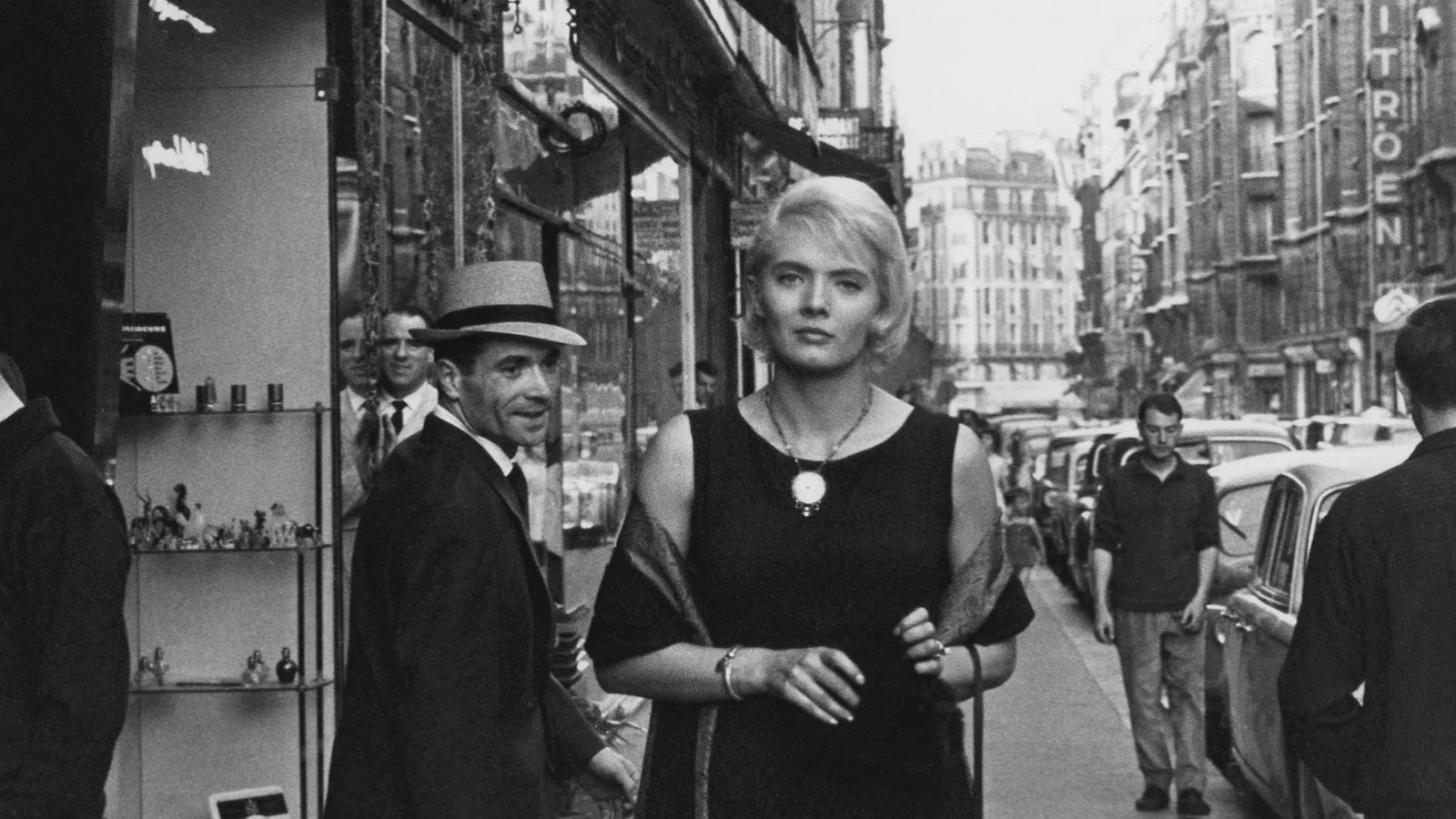
Cléo from 5 to 7 (1961) film notes by Robert Horton for the Nouvelles Femmes series, presented by Alliance Française, SIFF, and Greg Olson Productions. Series curated and written by Greg Olson. Inspired by the work of Ericka Knudson, author of "Nouvelles Femmes: Modern Women of the French New Wave and Their Enduring Contribution to Cinema" The series runs through November 2026 at SIFF Cinema Uptown.
There are many ways of looking at Agnès Varda’s
Cléo from 5 to 7, but let’s begin with light. As we experience them, movies consist entirely of light; we might put our hands on a sculpture and experience it as clay or bronze, or sniff the oil paint and trace our fingers across the canvas of a painting, but a movie is only light, projected on a wall or otherwise broadcast. So the way a filmmaker thinks about light ought to matter.
There is a scene in
Cléo that begins with two women getting into a car, which they drive into Paris traffic. After some whimsical banter, the title character (played by Corinne Marchand) expresses her anxieties about the medical news she is waiting to hear, and her friend Dorothée (Dorothée Blanck) sympathetically responds. The way the scene is shot would’ve been rejected by any Hollywood—or for that matter, Paris—studio. As the car pulls out of an alley, our elevated view is mostly blocked for a while by the railing between the camera and the vehicle. The camera tracks along and the car passes beneath an overpass, at which point it goes into complete darkness for a few seconds until gradually emerging into light again; in fact, the camera crew seems to have lost the car, because now it trails behind and has to catch up. A curious jump cut helps us come back alongside the car.
How thoroughly unprofessional—allowing a shot to plunge into darkness! Didn’t Varda have a package of lights? Shouldn’t we be able to see the actresses faces? But of course, this is the French New Wave, and we have seen how Jean-Luc Godard shot
Breathless with jump cuts, without artificial lighting, and with a camera and film stock meant for newsreels, designed to catch action on the fly. The New Wave directors wanted to rebuke traditional filmmaking by going the opposite direction, and here Varda flexes: She wants us to see movies in a new way. Something here is fresh, untidy, and not
cinema de papa, as the New Wave critics put it.
That shot-in-the-dark aligns with another of Varda’s career-long fascinations. When this director makes fiction films, they have a quality of documentary about them; when she makes documentaries, they carry a touch of drama. Varda said that
Cléo was “the portrait of a woman painted on to a documentary about Paris,” and in many ways that is how the film feels. When we watch Cléo walk on the street early in the film, in a shot from a high angle, we can sense that this is an unrehearsed moment with “extras” who do not know they are in a movie; the traffic around her is unchoreographed, the men who leer at her are real. This kind of texture lends a rawness to the movie-watching experience that must’ve felt very new in 1962.
Some of this might sound like so much film-critic noodling—except that Varda’s style is also what the movie is
about. We meet a semi-famous pop star who worries, in the course of two hours, about her cancer diagnosis. From the beginning, Varda takes a critical eye to this shallow, self-centered character, although of course Cléo’s mortal anxiety also makes her painfully human. In the course of the afternoon, the diva begins to lose some of her shellacked exterior (represented especially by a formidable ‘60s wig) and finds herself connecting with a humble soldier she meets in a park. Varda takes a critical eye to surface beauty, finding more excitement in authenticity (thus the unvarnished views of de-glamorized Paris).
Varda connects her theme and her style in the visit from Cléo’s lover, who does not really seem like much of a lover. They sit on a bed and the camera revolves around them as schmaltzy music plays; it’s the very image of a Hollywood movie scene, the kind of thing that conveys the most superficial ideas about “love” and which appears quite empty in Varda’s parody version. There are other parodies of love here, including the absurd silent film that features Jean-Luc Godard, his wife and star Anna Karina, and B-movie icon Eddie Constantine.
Varda’s casting of Cléo underscores this, as Corinne Marchard, who had had success as a nightclub singer (and had appeared in a film by Varda’s husband, the New Wave director Jacques Demy), is wonderfully chic and icon-like but somewhat cool and stiff in her manner, corseted in her designer clothes and that wig—when she sings the torch song “Sans Toi,” it’s as though she lets something loose that doesn’t fit her well-manicured image. (The song’s composer, Michel Legrand, is in the scene playing the piano; he would compose the music for Demy’s
The Umbrellas of Cherbourg in 1964.) By comparison, Cleo’s sympathetic friend Dorothée is first seen utterly naked—we’re in a life drawing class for artists, and she is the model—completely comfortable with herself and her environs.
As the only major female director of the French New Wave, Agnès Varda was the true
Nouvelle Femme of the era. But she carries no whiff of trendiness, nor of any simplistic visions of women in her films; she’s not here to be a cheerleader, but an artist. When we get to
Le Bonheur, we will see just how astonishingly uncompromising and unsentimental her vision was. For Cléo, the ticking clock that propels the movie is ruthless and almost cruel—it doesn’t so much build suspense as wear down our main character. The New Wave had charm to spare, and hipness; there’s no mystery why viewers might’ve emulated the cool Parisians on screen. But there is steeliness here, and a tough critique of the way things are. (Picture the close-up of the bone fragments in a box at the end of
Jules and Jim.) And for the women in
Contempt and
Jules and Jim and
Le Bonheur, the stakes are lethal. Within this wave, Varda isn’t playing nice.