


Don't miss your future favorite film!
Subscribe to our newsletter and get the latest updates from the SIFF community delivered straight to your inbox.
Don't miss your future favorite film!
Subscribe to our newsletter and get the latest updates from the SIFF community delivered straight to your inbox.
John Trafton | Tuesday, November 10, 2026
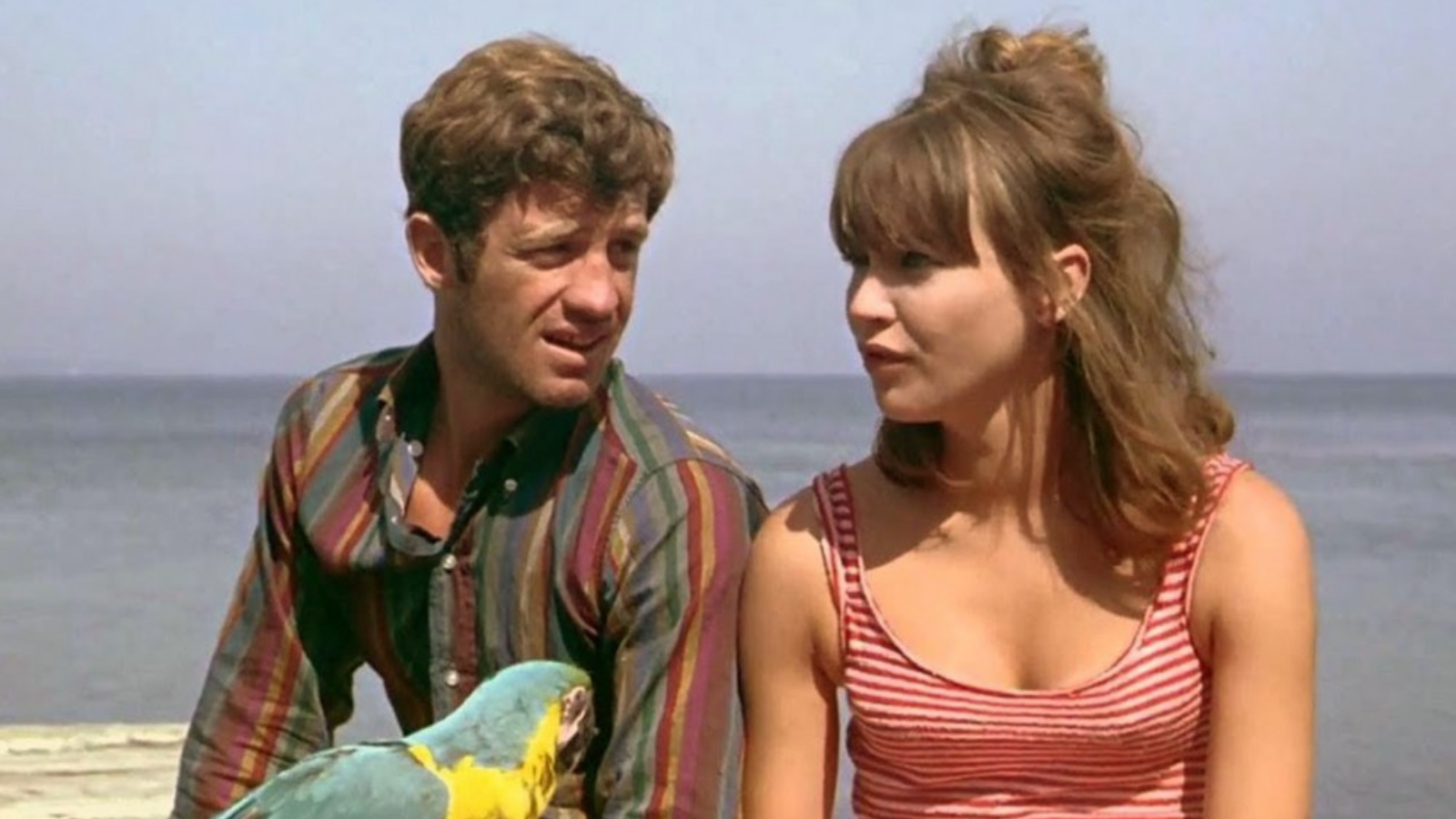
Pierrot le Fou (1965) film notes by John Trafton for the Nouvelles Femmes series, presented by Alliance Française, SIFF, and Greg Olson Productions. Series curated and written by Greg Olson. Inspired by the work of Ericka Knudson, author of "Nouvelles Femmes: Modern Women of the French New Wave and Their Enduring Contribution to Cinema" The series runs through November 2026 at SIFF Cinema Uptown.
Pierrot le Fou: Godard at the Edge of the World
Belmondo is back! Karina is back! And Godard is taking us to the edge of the world.
In Pierrot le Fou (1965), Jean-Luc Godard transforms the romantic road movie into an exploration of the impossibility of escaping history, representation, and the ideological structures of modern life. Ferdinand and Marianne attempt to abandon a world saturated by images, commodities, violence, and historical narratives, only to discover that their supposedly liberated existence reproduces many of the structures from which they are attempting to escape.
Their journey from bourgeois Paris to the seemingly idyllic Mediterranean coast promises liberation from a world governed by images. Yet the landscape they inhabit is itself a cinematic and literary construction, while their relationship gradually exposes the conflicting desires concealed within the fantasy of romantic freedom. What begins as an exhilarating rejection of narrative convention ultimately becomes a tragedy of authorship, possession, and the impossibility of transforming life into art. Godard would take some of these contradictions to even more absurd and apocalyptic extremes in Week End (1967).
The film begins in a world in which human experience is increasingly mediated through advertising, commodities, and the language of consumption. The bourgeois party depicts a world in which social relationships have become nearly indistinguishable from the commercial images and slogans that surround them. Ferdinand's dissatisfaction emerges from his inability to find an authentic existence within this environment. His departure with Marianne therefore promises more than a romantic adventure. It represents an attempt to abandon an entire system of representation.
Yet Godard immediately complicates the possibility of such an escape. Their journey unfolds through an assortment of literary references, cinematic conventions, popular music, painting, and pulp fiction. Even their rebellion against bourgeois society is expressed through the cultural materials that society has produced. The question is not simply whether Ferdinand and Marianne can escape Paris, but whether they can escape the images and narratives through which they understand themselves.
The journey from Paris to the Mediterranean suggests a geographical progression from confinement to freedom. The Mediterranean landscape offers an imagined refuge from the commodified world of the city, suggesting the possibility of a life organized around nature, contemplation, and romantic companionship. Yet this landscape is never simply natural. It is mediated through Ferdinand's literary fantasies, cinematic conventions, and romantic imagination. The landscape becomes another image, a seemingly timeless environment onto which Ferdinand projects his desire for an existence outside modern society.
History nevertheless intrudes upon this imagined refuge. The aftermath of the Algerian War, the Vietnam War, American imperialism, and the persistence of political violence complicate the fantasy of withdrawal. Ferdinand and Marianne cannot simply disappear into an ahistorical paradise. Their journey thus exposes a central contradiction: the farther they travel from the recognizable institutions of modern life, the more apparent their entanglement in its historical and ideological structures becomes.
The impossibility of escaping history finds its most intimate expression in Ferdinand and Marianne's deteriorating relationship. In Band of Outsiders (1964), the possibility of romantic connection remains open, however fragile. In Pierrot le Fou, that possibility is progressively destroyed. Ferdinand wants to transform their relationship into poetry, literature, and philosophical contemplation. Marianne desires excitement, action, movement, and an existence that cannot be reduced to Ferdinand's imagination. He wants to write their story. She wants to live her own. Their competing visions of freedom gradually reveal the limitations of Ferdinand's romantic idealism. His imagined liberation depends upon Marianne accepting a particular role within the narrative he constructs. Her resistance to that role threatens not merely their relationship but the entire conception of freedom.
A further tension emerges between Anna Karina's performance and the masculine narrative that attempts to contain Marianne. Rather than functioning simply as an embodiment of Ferdinand's romantic fantasy, Marianne continually challenges the terms through which he seeks to understand and possess her. The relationship ultimately exposes the possessive logic concealed beneath Ferdinand's desire for romantic freedom. His eventual violence demonstrates the destructive consequences of attempting to transform another person's existence into an extension of one's own narrative. The collapse of Ferdinand and Marianne's relationship coincides with a broader crisis of representation. Godard constructs Pierrot le Fou from fragments of literature, painting, advertising, popular music, pulp fiction, and American cinema. These are the cultural materials through which Ferdinand attempts to make sense of the world. Yet they cannot ultimately produce a coherent existence.
The film's apocalyptic quality emerges not from the literal destruction of civilization but from the exhaustion of the narrative and cultural systems through which individuals understand their lives. Ferdinand's final act brings these contradictions together. His attempt to turn his own death into a spectacular image represents the ultimate confusion of artistic expression and lived experience. Even his apparent change of heart cannot undo the consequences of that confusion. The romantic protagonist becomes both the author and the victim of his final image.
In Pierrot le Fou, the promise of liberation gradually gives way to the recognition that neither geography, romance, nor artistic imagination can provide an escape from history. The Mediterranean landscape cannot free Ferdinand and Marianne from the political and ideological structures of modern life. Nor can their relationship sustain the competing fantasies of freedom that initially bring them together. What begins as a journey toward an imagined paradise becomes a confrontation with the limitations of romantic authorship itself. Ferdinand's destruction is therefore inseparable from his inability to recognize Marianne's autonomy. His desire to escape the world ultimately depends upon constructing another world in which he remains the author of their shared existence.
At the edge of the world, Godard discovers not freedom from representation, but its devastating consequences.
Don't miss your future favorite film!
Subscribe to our newsletter and get the latest updates from the SIFF community delivered straight to your inbox.
Don't miss your future favorite film!
Subscribe to our newsletter and get the latest updates from the SIFF community delivered straight to your inbox.