


Don't miss your future favorite film!
Subscribe to our newsletter and get the latest updates from the SIFF community delivered straight to your inbox.
Don't miss your future favorite film!
Subscribe to our newsletter and get the latest updates from the SIFF community delivered straight to your inbox.
Ericka Knudson | Film Scholar | Tuesday, September 29, 2026
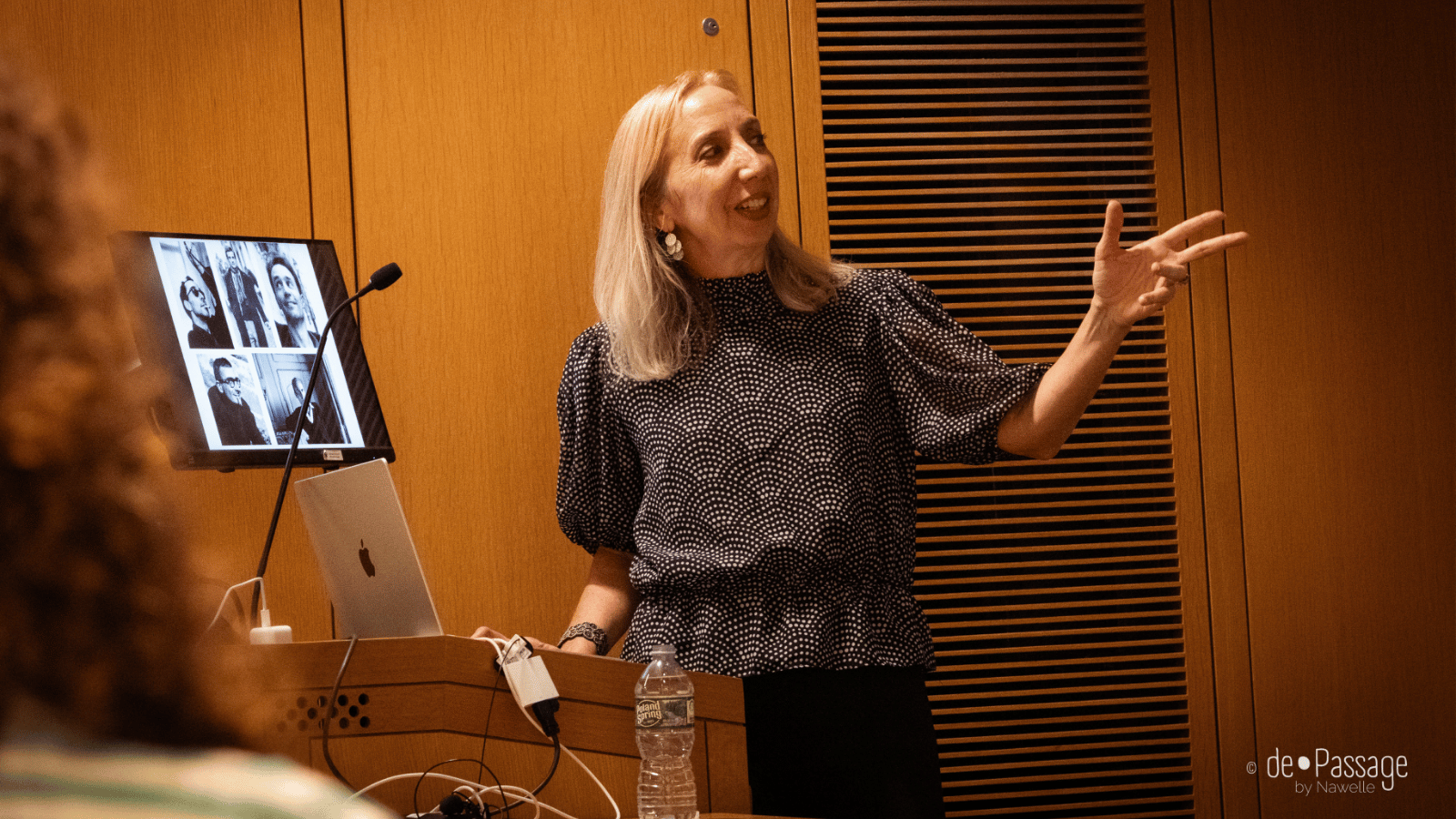
Above: Ericka Knudson presenting a Book Talk at Princeton University
Growing up in Texas, with dreams fed by books and movies of faraway places, I arrived in Paris at twenty, an idealistic young romantic. While I started out studying French literature at the Sorbonne, secretly, I was searching for a life inspired by the French New Wave films I had recently discovered and fallen in love with, one shaped by meaningful conversations, an appreciation of beauty expressed through art and literature, mixed with lighthearted joie de vivre— one that followed in the footsteps of Jean Seberg strolling on the Champs-Élysées in À bout de souffle, Jeanne Moreau racing across the Valmy Bridge in Jules et Jim, of Anna Karina dancing the Madison in Bande à part.
After completing my degree (but determined to prolong my Parisian adventure), a twist of fate led me back to my passion for cinema and to a decade of research on the Nouvelle Vague, a journey I never wanted to end. It ultimately culminated in a doctoral dissertation on love, literature, women, and the New Wave: De l’amour, des femmes, et de la Nouvelle Vague: reconfigurations culturelles et création d’une modernité cinématographique française (2011).
Although les femmes appeared in the title, I realized later that in my research, I had in fact concentrated primarily on les hommes: the venerated (male) directors known as auteurs. I went on to teach courses on the French New Wave in the decade that followed. And while I remained fascinated by the women who appeared in these films, my admiration for their (mostly male) directors’ cinematic creativity kept me from fully seeing the women’s contributions, overlooking the many ways women had influenced the films and shaped the movement—both in front of and behind the camera, as well as behind the scenes.
I came to recognize this imbalance only in retrospect, as I began to explore the women’s contributions to the French New Wave, as I researched their stories, showcasing them in my book, "Nouvelles Femmes: Modern Women of the French New Wave and Their Enduring Contribution to Cinema" (Chronicle Books, 2025), a project conceived with and produced by Chris Navratil. As in cinema, creating a book is a collaborative art, and it taught me to appreciate the transformative power of encounters. The magic of Ascenseur pour l’échafaud (1958), for example, was born of the personal and aesthetic encounter of Louis Malle with Jeanne Moreau, and the serendipitous arrival of Miles Davis with his improvised soundtrack. We can trace the trajectory of a film, and of the actors and directors involved in it, through these kinds of decisive encounters that altered the course of their careers and sparked stylistic breakthroughs. Photo by Ericka Knudson, taken at Le Salon du Panthéon
With a distance of almost seventy years after the slogan “La Nouvelle Vague arrive!” appeared in the press (see journalist Françoise Giroud’s feature in L’Express, Oct. 3, 1957), we can see how the New Wave changed cinema as well as society, offering new models for living and relating, including greater possibilities for these nouvelles femmes. Through them, we can measure how far we have come, what we still share with the New Wave generation, and how much remains to be done, especially in terms of women’s roles and recognition. As philosopher Elisabeth Badinter pointed out in her book "Messieurs, encore un effort..." (2024), society must dismantle the unspoken expectations of women that still persist in order to attain true equality.
Reframing the women of the French New Wave shines a light on these concerns and provides a measuring stick for steps forward as well as steps back. We can appreciate the new voices brought to the screen by Anouk Aimée, Brigitte Bardot, Françoise Dorléac, Françoise Fabian, Anna Karina, Macha Méril, Jeanne Moreau, Emmanuelle Riva, Jean Seberg, Haydée Politoff, Delphine Seyrig, and Agnès Varda, as well as others like Bulle Ogier, Jane Birkin, Romy Schneider, and their contemporaries. We celebrate the encounters between directors and actresses that helped create more authentic representations of women on screen in films that, in turn, changed the ways women could see themselves off screen, opening up new possibilities for agency.
Some bastions of the New Wave have lived to see a new generation of women continue the struggle for power and agency that they themselves fomented. As Macha Méril recently noted, for example: “A new world is being created with a very new way of living,” one that is “still under construction.” Agnès Varda, one of the few female directors of the New Wave era (who in fact preceded the movement by four years with her first feature, La Pointe Courte, 1955), worked her whole life to make not only her voice heard, but those of others who had been overlooked, adding to the conversation through her films and artistic endeavors. In her 1975 short, Réponse de femmes (made for French television on the occasion of “l’année de la femme”—the year of the woman), Varda leant a voice to a variety of women and emphasized the importance of a continued dialogue between women and men. The final dialogue of the film is between women, men, and Varda herself, calling for humanity to help reimagine views and behaviors in a changing society, a message we can adopt and adapt for our own evolving world. As in my book, "Nouvelles Femmes", I leave the last word to Varda:
Une femme: We women are taking charge of our evolution, and if you still need women and love, it’s you who must change your habits and some of your tastes.
Une femme: I am a woman. Women must be reinvented.
Un homme: Then love must be reinvented.
Les femmes together: Okay
Varda (in voice-over): In that case, to be continued...
The women in "Nouvelles Femmes" were more than muses of the Nouvelle Vague directors. Along with their modern presence on screen in new types of roles, off screen, they were writers, activists, poets, and directors in their own right, following in the footsteps of Agnès Varda. The book tells the stories of the women who made the New Wave modern.
Don't miss your future favorite film!
Subscribe to our newsletter and get the latest updates from the SIFF community delivered straight to your inbox.
Don't miss your future favorite film!
Subscribe to our newsletter and get the latest updates from the SIFF community delivered straight to your inbox.