


Don't miss your future favorite film!
Subscribe to our newsletter and get the latest updates from the SIFF community delivered straight to your inbox.
Don't miss your future favorite film!
Subscribe to our newsletter and get the latest updates from the SIFF community delivered straight to your inbox.
John Trafton | Wednesday, October 28, 2026
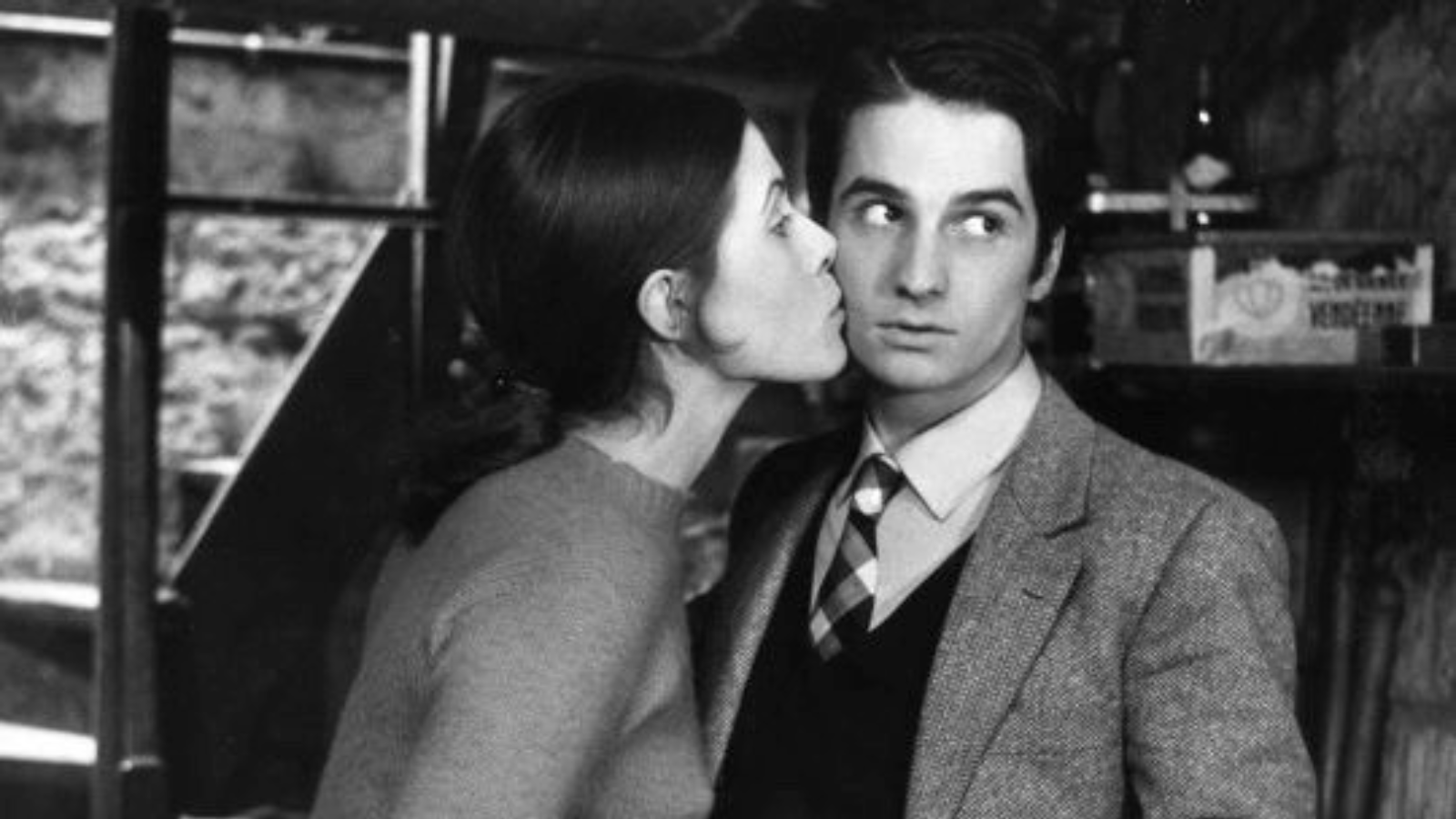
It is surely an unfair advantage for François Truffaut to begin Stolen Kisses with Charles Trenet’s indelible song “Que reste-t-il de nos amours?” (the English-language version is damply titled “I Wish You Love”), a 1943 tune that catalogs the memories of love, set to a melody of perfect French bittersweetness. The title of the movie—Baisers volés, that is—comes from the lyric, and the movie itself has the fragmented, whimsical quality of recollections that do not come together as a story so much as they form a mosaic of the absurdities of the youthful heart.
As grand as that sounds, there is more happening here. Stolen Kisses is really quite eccentric: the opening imagery focuses on Truffaut’s beloved Cinémathèque, which had recently been closed by French authorities—nothing to do with the movie we are about to watch, mind you, except that much of Truffaut’s coming-of-age was spent there. Post-credits, the film shares a typical romantic vista of the Paris skyline, from which the camera descends to a nondescript location, which turns out to be a miserable military prison where Antoine Doinel (Jean-Pierre Léaud) is currently incarcerated, and about to be dishonorably discharged—to everyone’s relief.
Antoine is a significant character in French cinema, his story told across four features and one short film, beginning with The 400 Blows (1959) and ending somewhat half-heartedly with Love on the Run (1979), all created by Truffaut and played by Léaud. It is a touching trajectory, and the process of seeing Léaud grow up on screen, obviously loved by Truffaut (the director filters his own autobiography through the actor), is not quite like any other film series. However, you do not have to have seen any of the other films to appreciate Stolen Kisses. Even a scene in which a now-married character from a previous chapter—the 1962 short film Antoine and Colette—appears for a brief catch-up with our hero, is frankly not so dissimilar from the episodic nature of the rest of the movie.
At that point, we’ve probably gotten accustomed to this apparent randomness. Take, for instance, a scene in which Antoine recounts a story to a minor character, an event drawn from his new job at a private investigation firm. (Since his discharge, he’s tried to get back together with former flame Christine [Claude Jade], gotten fired from a job as a hotel night clerk—“being a clerk at night gives you a lot of time to read”—such a Truffaut sentiment—and gone undercover in a shoe store.) The anecdote has something to do with following a woman who, working as a nanny, moonlights as a stripper when she takes her toddler charges out for fresh air.
What is the point of including that? Or including the 60 seconds spent on the pneumatic system of mail delivery in Paris, or a lesson in how to butter biscuits, or the fact that Antoine never uses paper to blow his nose—practically the last thing he says in the movie. The film’s final scene, even though it completes a running theme about following people, is itself a non sequitur. Some of these moments are motivated by desire; we can feel the urgency of Antoine’s love note passing through the pneumatic system, and imagine him imagining its fervent progress underneath the city. And when Christine takes on the job of biscuit-buttering (“I’ll teach you everything I know”) she all but confirms the couple’s betrothal. But other events simply seem like scraps of memory, the stuff of life that is usually left out of movies in the need to press the plot forward.
This quality is why many of us love Truffaut’s films. His tender affection, his noticing. A certain amount of bitter with the sweet. In the relatively short amount of time he has left on the planet, Antoine’s private-eye mentor (Harry-Max) is allowed a moment to note his appreciation of the pork and lentils at a particular restaurant. Even the hapless owner of the shoe store (Michel Lonsdale), who correctly suspects that no one actually likes him, can be—well, not sympathetic exactly, but at least a figure of pity, however briefly.
The nouvelles femmes here are Claude Jade, who nearly married Truffaut offscreen (she appears in the two subsequent Doinel films), and Delphine Seyrig, whose formidable career included central roles in Alain Resnais’ Last Year at Marienbad, Luis Buñuel’s The Discreet Charm of the Bourgeoisie, and Chantal Akerman’s Jeanne Dielman. Seyrig’s elegant Madame Tabard embodies a wonderful figure for our ardent, bewildered Antoine: somehow both earthly and remote, glamorous yet blunt. Women do not seem especially real to Antoine, unless they echo something in a Balzac novel. A novel that Madame Tabard has absolutely read.
The film belongs to Jean-Pierre Léaud, of course, and it is his clumsy charm that makes Antoine’s disastrous understanding of women seem all too human. Less than a decade after giving one of the great childhood performances in The 400 Blows, Léaud still seems unformed, someone who never quite got civilized or properly instructed in the ways of life (buttering bread is just the beginning); at times he doesn’t seem to be acting so much as reacting spontaneously to something unexpected that happens in the scene. The way he barely stifles his grinning as his military commander lists Antoine’s episodes of going AWOL introduces us to Antoine in a definitive way.
Truffaut was a wild child himself, and he put some of his own experiences in the Doinel films. But you can see that it was a two-way street, and that Truffaut cherished his awkward leading man, keying entire sections on Léaud’s ungainly maladroitness. Poor Antoine can’t even wrap a shoebox. Truffaut is there to make sure he gets the job anyway.
Don't miss your future favorite film!
Subscribe to our newsletter and get the latest updates from the SIFF community delivered straight to your inbox.
Don't miss your future favorite film!
Subscribe to our newsletter and get the latest updates from the SIFF community delivered straight to your inbox.